Artist's Date #59 - Dance using a Primary Text
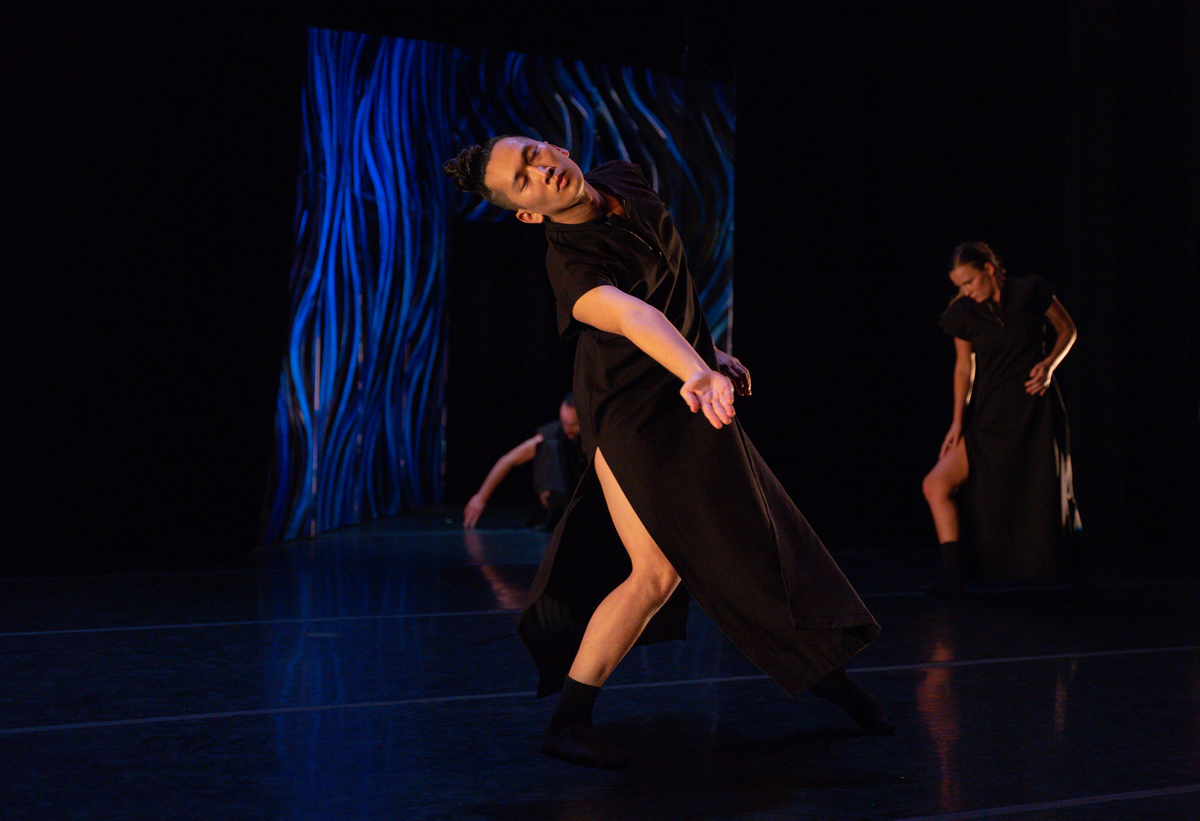
When I went to see FACT/SF’s performance of The Waves I knew only about Virginia Woolf’s book and had taken the artistic director, Charlie Slender-White’s, countertechnique dance class at ODC.
I remember the class well because it was so hard and confusing but also so different. The people in the class moved like dancers but also like science-fictional creatures and, from what I gathered by taking the class, this had to do with what the dance technique says about the central unit of the body and how it responds to gravity. Either way, the class was made of dancers and I am not one and when I got flustered Charlie was like - you have to ask me to make adjustments to the exercise for you. That’s my job, that’s what I’m here for. It really touched me that he understood his assignment was to make his own work accessible and I think that’s what he also did here, with his dance based on the book.
At first, as I watched, I was caught up in thinking. For example, did I like the dancer’s costumes, which were monastic in form but also cut up the legs? What about the placement of a small sub-stage at the back and its techno naturalistic projections? Did the duets, which were paired not only by gender but also by movement material, work for the piece? I found I was trying to tally it all up to see if the number landed more on one side.
I began to get bored of doing math. I thought of leaving. When I committed to staying, the revelation began.
My brain shifted from thinking to looking and when I did I saw four people moving in unison, in their cloak-like black dresses, legs often exposed, doing the movements I loosely understood as having a not-ballet like purpose and I saw something else. Two of the dancers were dancing not only with their whole bodies - meaning through the ends of their pinkies most certainly, but also behind their eyes.
I’ve seen this only twice before – once in a general way when I’ve watched Indian dancers for whom I know that eye placement is an important part of the choreography, and another time when I saw Rebecca Bruno use this kind of technique when she was dancing in unison with two other dancers in a video I saw at the Hammer Museum. When I saw her I noticed how that exact movement, the way the eyes moved, made her body stand out so far from the rest.
In the case of these dancers in front of me I began to notice the presence of a whole story that was visibly dancing inside them. I went from being a bit bored, wondering if I should just leave, doubting whether I really know how to write about dance to begin with and whether I just like to be in a dark space with others, in more ways than one - to being totally present. Instantly more awake on the inside of my body like I had a reason to be right where I was. Their gazes, so fixated on their internal experience, pinned me right to my seat.
At the end of the dance Virginia Woolf scholar, Elizabeth Abel, got up on the stage and spoke with Charlie and the dancers, who I learned through the Q and A were actually the ones who made all the movements through a collaborative process.
There were a few questions from the audience and one person asked: when did you “get” it, what the dance was, and what Charlie said astounded me. He said the whole thing was made without music and he / they kept trying different tracks to the movements that were already made. When he finally layered on the music he eventually chose he found it just landed. The Woolf expert weighed in and said that she noticed the violin that was so active in the music, Recomposed by Max Richter: Vivaldi – The Four Seasons, is an instrument that plays a part in the text.
I didn’t know this because I’d never finished the book, and actually neither had some of the dancers (they admitted when asked, one by one, to go down the line). One dancer, Jonathan Kim, said it was his artistic choice not to read the whole book but instead, to just read the clips that Charlie had provided so he could be more in the choreographer’s vision than one of his own. He said that that clip he received was what he kept in his mind while he danced.
That, I thought to myself, was what I saw then, what was behind his eyes. It was some relationship to the text that he held in his mind while he danced. After the Q and A I told him I had seen evidence of that holding, and that it had made all the difference.
I felt the circuitous nature of Woolf’s language in the larger text was not as much in the piece as I might have imagined. I wondered whether that was just what a writer saw versus what a dancer saw, so I asked Elizabeth, the Woolf expert, what she thought, even though she’d already said publicly that she thought he’d nailed it.
She kind of took me all in and said that in fact her experience of The Waves is that it’s about the monotony. I think she knew, even in two seconds at the end of the show, the question underneath my question - which was about why I had been looking for myself in the work and then had gotten bored. As we agreed that if that was true, then the costumes, the zen-like design, made a lot more sense and before we could land on anything further, the stage filled with people as the Q and A concluded, all of it including my own reaction began to fit together.
In the quiet program notes (for a larger three-week series), ODC Theater's Creative Director, Chloë L. Zimberg asks us to: ...sit together in the fragments—and see what, if anything, becomes whole. While I'm suspicious of wholeness, this furious violin has become part of my montage of selves.