COME INTO BEING
One Piece #7: Marcus Fischer's Collage Diary
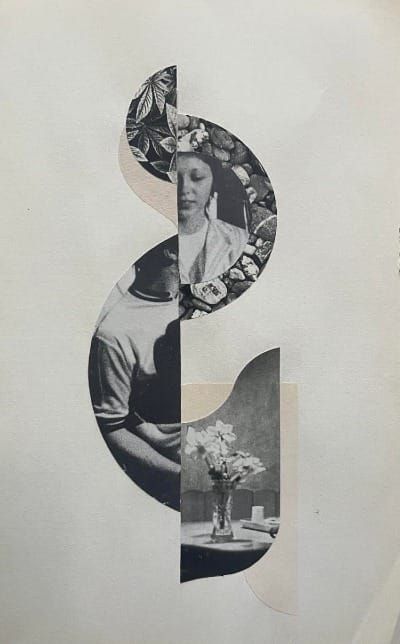
This installment of the One Piece essays is actually about a series of 365 pieces, only half of which are technically done. I came upon this work by Marcus Fischer at the Headlands Center for the Arts Open Studies this spring, where he had generously pinned about fourteen small works on paper onto his studio wall. The pages, about 4X6 inches, were all made using the paper from used books and composed using photographic elements from found sources.
Without knowing what the project was at first, or even these material constraints, the pieces together created a clear visual language. Dark sections curved into black and white figures, all in the center of an aged manila rectangle. The visual result was a meeting between surrealism and Bauhaus, two art traditions I love that I would not have previously thought would fit together. Looking at the repetition of the figurative and realistic pieces, collaged together, alongside stark bold but also intentionally lyrical shapes, created a visual alphabet, much like the ABC’s lined up on a classroom wall, only they were the fundamental building blocks of this artist’s mind and emotional life.
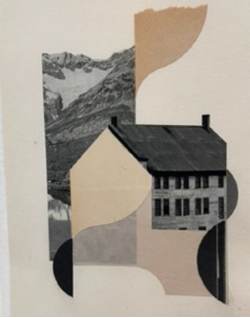
I was honestly captivated. The small pictures held so much inside them. In one, a small military-like structure stood next to a vast open space, up against a textured and high positioned-background. The Headlands Center is just north of the Golden Gate Bridge and sits on a grassy area over the mountain from the Bay and down the road from the ocean. I assumed the image was a picture of the building we were actually in, but when I asked Marcus he said that it wasn’t. Instead it was a picture that he’d found, just like the rest of the photos in the collage pieces, which he put together at night before bed as a kind of diary of his day. Every day. Without missing one.
My friend walked out of the room but I couldn’t leave. On the side of the room, SO INNOCUOUSLY LAID, were all the pieces to the series that were not on the wall. They were almost like found objects themselves, in a little box, waiting to be discovered. I looked through them, turned them around and noticed the little hints of artist process behind the visuals. In pencil, each image was labeled with the date and the number in the series with the artist’s initials in script. It took every bit of me not to try to put them all in order. Something inside me felt desperate to find #1. To see how it started. To understand how one thing became a set of things which became more than itself.
Look at the early ones! I shouted to my friend who had come back into the room. They are just a whisper. A strip of cream on top of the brown page, with another darker ripped piece on top, just a tiny bit shorter, and then a third slip on top, the ends turning the work, through the layers and torn ends, from paper to fabric. I held my breath as I imagined how easily this impulse could have been stamped out with another demand.
I started seeing how the series evolved - there was a crouched figure in a martial art stance, standing on a black landing strip in front of a white portal with a shadow on its right side - all of this narrative summoned by a rectangle, a triangle and an oddly shaped piece of white paper torn at the top. A slip of cloud with a crescent shaped cut out from the side, with a small white moon of its own were like worlds within worlds within worlds. A mechanism was operating within the images - which made a complex thing, like the universe, simple and approachable and the simple things, like a hallway, turn into something otherworldly.
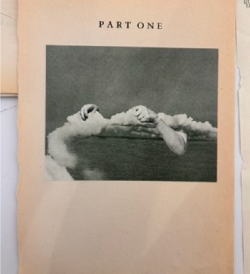
Finally I did find number one. In it, two hands (and one arm) extend from a center-framed puff of white clouds. Without a baton in hand they read to me as conductor, as if the artist might have asked some sky-being to be in charge. Turning one picture over I saw the name of one of the chapters where the backgrounds were torn: The Practice of Spiritual Direction (for 02.14.26). I imagine that the constraints of the materials is paradoxically what creates the great freedom found in the #’s that followed.
I asked Marcus, via email, for permission to use a few of my snapshots which I took, guiltily, while in his studio. He agreed and sent me more as well - pictures of where the series has gone since the Spring.
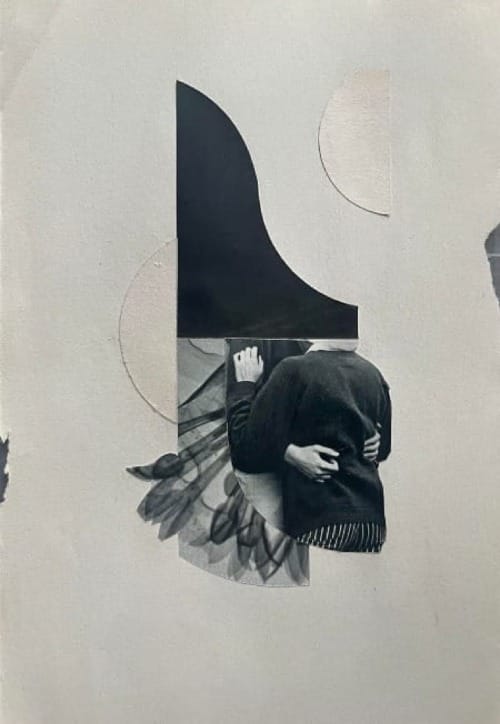
The figuartive portion of the collages have gotten even more intimate and the relationships between those parts and the solid black pieces have gotten more and more profound and fun to interpret. In the first new image I saw the top of a grand piano, one of my favorite shapes in the world, sliding down into two well-dressed people’s bodies in an urgent dance. Another (the one at the top of the story) a mix of sinister possibility and quotidian pleasure — as a woman with flowers surrounded by edges of garden stands above blooms in a vase that, all together, forms a larger shape that curves like a snake.
While we do see popular versions of this practice (I'm thinking of Instagram and I cannot believe the artist had the restraint not to position these there), it’s rare to see a project’s cumulative effects in such a short time. This could be attributed to the artist’s repetitive practice of this repetitive practice – he’s been doing daily year-long projects every few years since 2009 – but I think there’s something more happening here than just harnessing zen. Much like the contrast of art histories found in the images, the pairing of utilitarian discipline with a gentle touch is what gave this work a feeling of something preexisting that is being uncovered, one piece at a time.