Artist's Date #57: Peter Cordova at Et al.
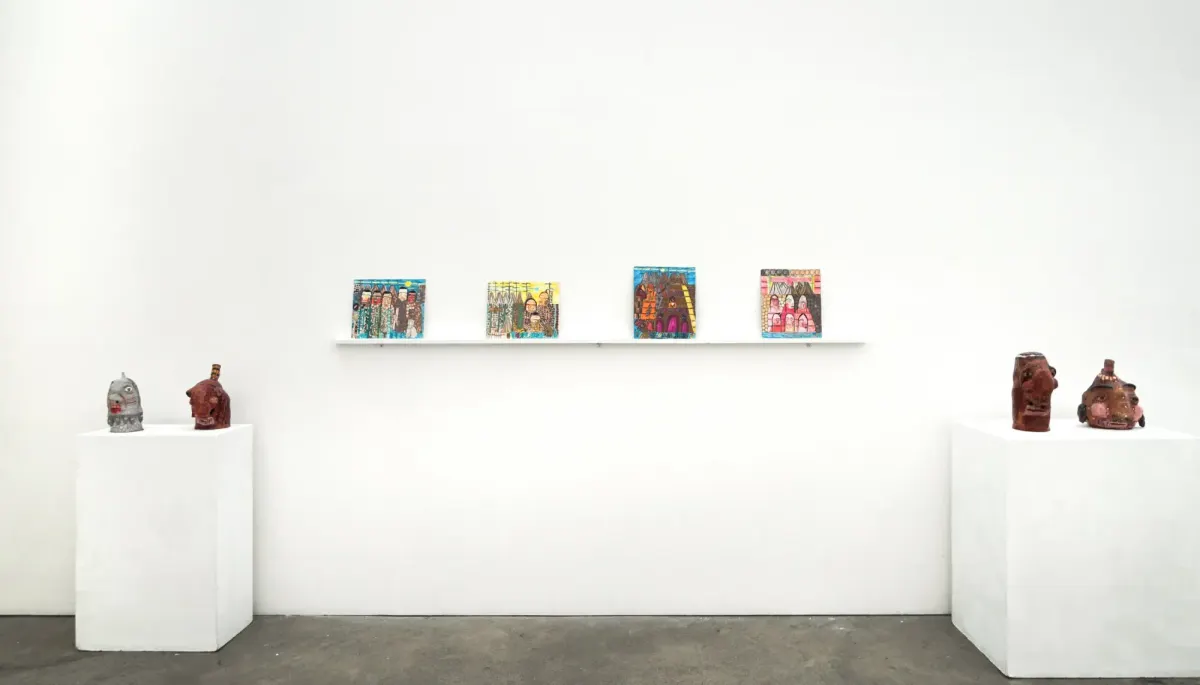
The art writer’s group from The Bathers Library went to Et al. two Saturdays ago and caught Peter Cordova's sculptures and illustrations in the middle room of the gallery. Cordova is a member of Creativity Explored and his artist’s statement explains that he always uses a grid to lay out his pictures. This was very evident because not only could you still see the grid, you could see the artist’s intention to make use of the space in a particular way. It needed to be filled all the way up.
What struck me most about his images was the way that the figures were merged with backgrounds. On each canvas there were different elements: people, animals, houses and plants. And yet none was drawn with any more weight than the other. All of the objects had equal significance. Except maybe sometimes the sky – a rare moment of negative space, and also sometimes a moon sitting inside it.
The room was full of these pictures - maybe thirty – all the same size, all the same style. Instead of feeling overwhelmed by the pictures, one after the other I felt kind of comforted. Like these pictures were blankets thrown over me. Like I was living inside of something very coherent where there was an order of things: but the order was that things all went together.
I felt like what I was seeing wasn’t markers on a flat canvas but rather some kind of pattern for textile. There was a narration in the imagery, that felt very quilt-like – each one a kind of tableau vivant, like a scene from a story. Also, the figurative work was so different: not taking the foreground but taking the same field as the background. This made a flattening of the image which, in turn, made it feel as if it could be printed.
There were other hints at what I began to view as material – markings that almost illustrated a stitch, repeated for emphasis, rather than another pen mark. I could have seen these as graphic design references but there was also something about how simple the marks were that made me feel like they were active, like they were indicating something that would be three dimensional and also hand made.
There was also something maternal to me about how the figures stood so closely together. The children squeezed between parents. And the women held together in the same frame of a home. Or perhaps in the grids of their own companionships. Maybe that’s also why I kept thinking of blankets and about comfort: that these pictures were making a formal argument about how to belong.
Finally I’m thinking about mothering, of course. And how it asks you to see caring for others as inseparable from caring for yourself. The figures in these drawings disappear in a way that figurative drawing usually doesn’t. In this case they disappear into the other figures who disappear into the mountains that disappear into the sky and all of them disappear into the fabric of life.