Artist's Date #56: Works-In-Progress
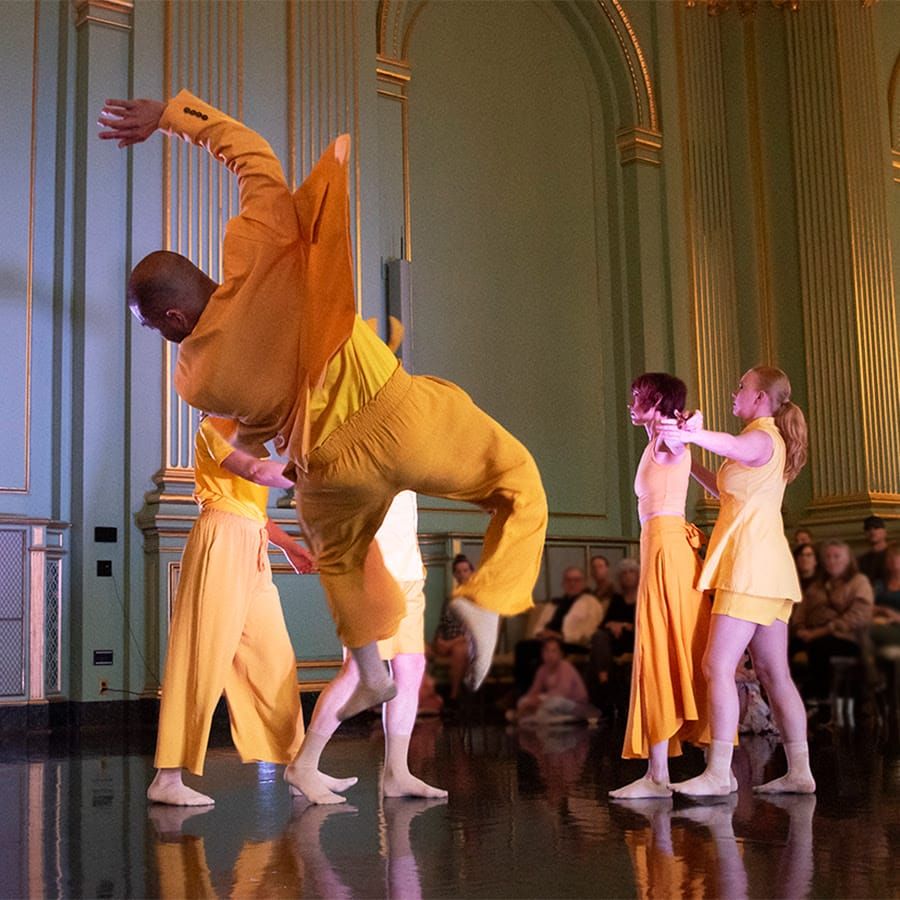
RAWdance’s series, the CONCEPT, which presents works at various stages of the creative cycle, takes place in the Green Room – an ornate, high-ceilinged room on the second floor of the San Francisco War Memorial building.
At #34, on April 10th, which I attended, the audience there seemed to be made up mostly of dancers, since lots of people had superior posture or walked with extra grace. I vowed to work on my own physical expression as I observed these alien humans – long, lean and constantly poised.
The room was separated into two sets of chairs on either side of the middle of the room and there were drinks as well as popcorn and snacks that we were encouraged to eat throughout the show. Sometimes the people who run RAW gave them out between each dance which contributed to the casual and welcoming tone.
The performance began with a duet between two dancers I read as being about remaining difficult relationship or about the difficulty of caring for someone with mental health issues an addictions. I got this message through the coming together and coming apart nature of the choreography as well as the repeated motions used by one dancer when the other could not make much contact. As I read the notes after I saw that this interpretation was personal and the Untitled work by The Straw Dogs, was actually made from two solos, choreographed separately, to the same piece of music and then put together to see how that worked.
The second piece was a solo which felt a bit like reading a memoir about a topic you don’t have experience with. In some ways a solo feels different than dance, though to say that would be like saying that memoir is different than writing. I grapple with this myself - how much one person’s experience can be important enough to garner attention and how sometimes it can feel too voyeuristic to be in the audience, or to read work of that kind. As such, A(laj)a Badalich’s as within, so without - of one, felt too lonely for me, though that might also be considered successful.
The third piece scratched all the right spots. When the first dancer came out with a yellow dress and some kind of foil over her face, I thought ok now we are talking. As the dance progressed the performers moved across the space more in what I think of as theatre tableaux rather than what I recognize as traditional dancer group shapes. Rather than being arranged with respect to the audience they were arranged with respect to each other, which made the experience of watching them enjoyable.
This yellow-clad dance, by the RAWdance group, was called Echo, Studies I read as being about living in the present alongside an imagined future and how to be human through the passing of time. The costume colors were yellow — sometimes beautiful and laying lightly, and at other times a kind of generic color reminding me of a temple uniform in which you aren’t quite sure which color yellow you would end up with yourself. The yellow both stood out and also came off as unspecial, which I’m thinking about because of last week's story about whether yellow has anything to say about art that’s different from other colors.
Often there was a contrast in the movements between the group of dancers: some were dancing in more recognizable ways, and others were more moving as if they were not dancers at all. Then those movers would begin to dance in ways that were recognizable as dancers and that shift worked well to elevate the dance movement and to show that dance can be both conforming and not, and movement may not look like personal expression at all.
A large section of that dance was made with the performers holding mirrors up to their faces. It seemed to be about how being too close to your reflection can isolate you from others, since they were all on stage together while holding the mirrors but not resounding too much to each other. I now don't remember if other bodies were holding the mirrors up to another dancer’s face or if the dancers held the mirrors themselves. Eventually the foil on the faces of the first performer and another performer came off and there was more of the dancing together. In this piece there was also a soloist who seemed to be of the now, despite the same yellow garb. I think the reason for this was that she shared her grief which was absent in the movements of the dancers around her. It almost seemed like this natural human emotion was more alien now in the landscape of what we imagine the future to be.
After this piece another solo, Monique Jenkinson’s How Do I Look was both humorous and tragic – a straightforward read about the exhausting theatre of being a woman, of performing femininity, and its physical costs.
In the following piece, an excerpt of Natalya Janay Shaof’s CURRENTS, two dancers moved together and apart, often with long silky cloth, and they danced together and for each other, often mirroring each other’s movements. The central theme felt to be about the power of leaning into our own emotional bodies and the emotional lives of one another.
And finally, the last excerpt of Where have all the flowers gone, by the Pearl Street Dance Collective, reminded me of friendship of playfulness and of the difficulties of youth — with three dancers who seemed to be making their way through a landscape that was unfriendly, and they either did or didn’t rely on each other.
Overall I felt that this works-in-progress format was a creative way to approach dance and performance. The informal space and inexpensively priced tickets made access easy and the central location made the work seem important to the city at large. Seeing each dance next to the others made it easier to think through the themes, and the different dancers with different works reminded me that dance itself is not monolithic or as static as non-dancers might often think.
The snapshot view of works at different stages was humbling, reminding me how much work goes into each performance that gets to the stage and perhaps giving credit to pieces that do not always make it all the way through to the end or mutate so much in the making that they become later something else altogether. I wondered whether other art forms might benefit from this kind of showcase; where community making happens because of real observation of what’s happening now, not a judgment about the value of what has been done.