

UNFOLDING TIME
One Piece #2: Brittnay Britton's What She Carried / What i brought @ the de Young

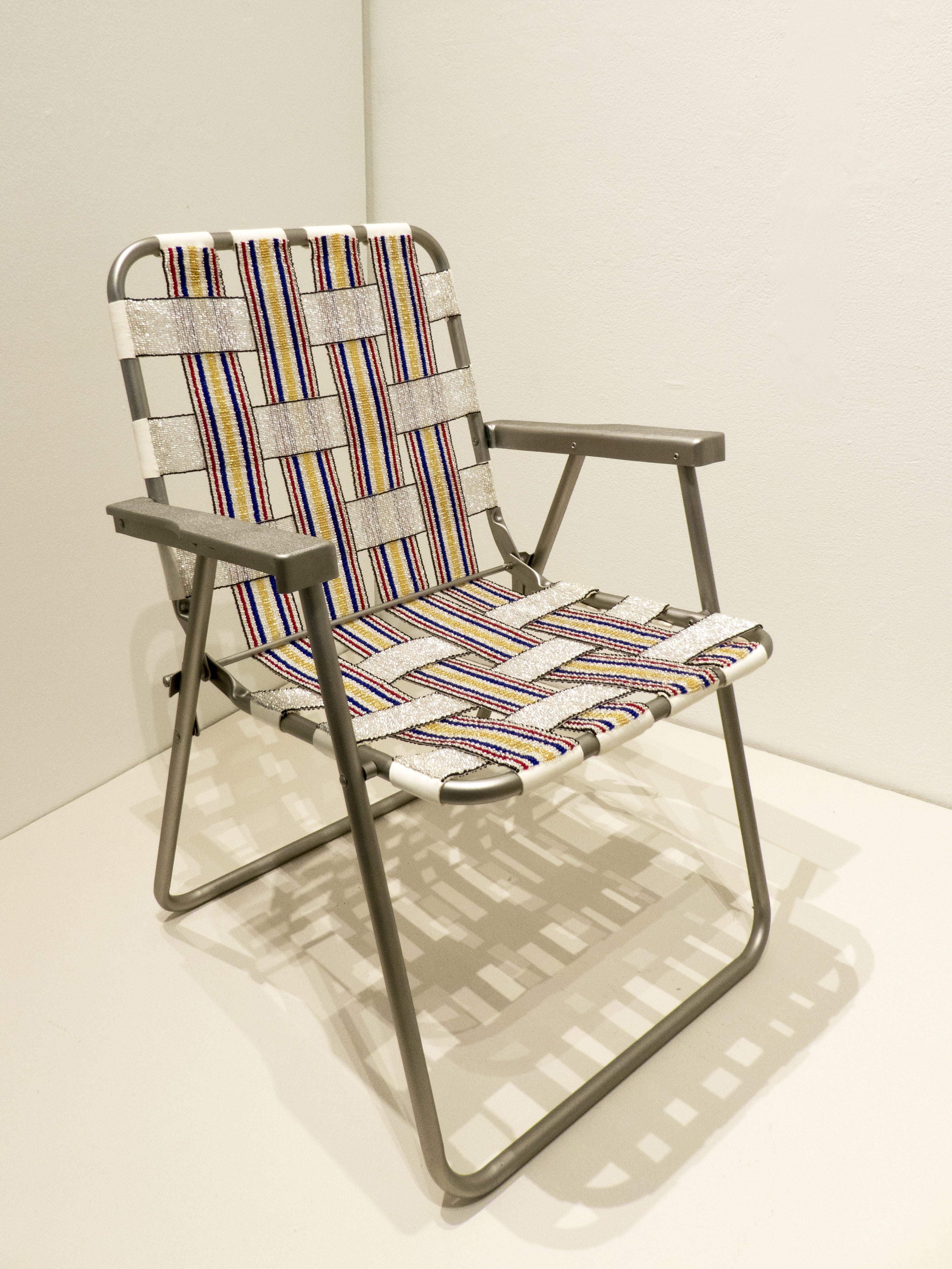
Last week, I wrote about one piece that I loved in the de Young’s newly revamped Arts of Indigenous America gallery, starring a friendly and energetic salmon character with a great life ahead. What I didn’t mention was that the painter’s biography moved me as well. On her website, she notes that she is responsible for bringing back the Karuk girls’ puberty ceremony that had been dormant for over 100 years. I wondered whether I had somehow felt this—a feminist stance patterned deep in her painting, and how, without directly addressing this politics, I felt it came through.
I felt the same way about the next piece that I loved—the folding chair (above) by Brittany Britton. The chair is a regular folding chair, but instead of the straps being made of synthetic fabric, they are constructed out of strands of glass beads. Next to the chair was an artist’s statement about her great-grandmother, who was known for bringing her own folding chair to ceremonial events.
This is a copy of an original lawn chair that my great-grandmother would take to our world renewal ceremonies. I wanted to highlight the way I saw this as a tangentially ceremonial object, and did this through the material I chose to create a copy in. The brightness and light catching quality against a basic aluminum chair frame gives it the ethereal light it deserves, she writes on her website.
I wondered whether it was unusual for someone to bring a lawn chair to a ceremony. Was there something rebellious about her grandmother doing this, or had it just struck the artist as notable and overlooked? Either way, I felt her intention. By using beaded straps, the artist made the opening and closing of the chair into its own ceremony, and ordained something that was perceived as ordinary and maybe even expected.
I thought about all the everyday things that women, in particular, do over and over and how there is a kind of sharpening and a glistening in that repetition, that things done with attention, day after day, can create their own kind of beauty. I also thought about how so much of that work is either unpaid or underpaid, and how giving it reverence through artwork is one way to give these acts more cultural value.
In another text, the artist’s grandmother is cited as being a Hupa medicine woman, and I wondered about all the other ceremonial objects the artist might have used to honor her grandmother. The chair, in its basicness, lacks any intrigue, and so it’s something that an outsider might pass right over, but also something a curious and lucky person might also wonder about.
The artist’s statement didn’t mention her grandmother’s community role at all, and I wondered if Britton wanted to highlight a less novel skill. Is just showing up, again and again, as a witness or a participant also a service? Or is it that she never made a big deal of her importance, and sat in the same kind of chair anyone else might have used? This is a kind of story that brings you in, and I wonder also whether that kind of community telling isn’t also a piece of this sculpture’s puzzle.
Even without the beading, the lawn chair made me think about Brooklyn and Queens, where my grandmothers raised my parents, where a light chair like this might bridge the public and the private. The front stoops of buildings like extensions of living rooms—only outside the house, and also out front—a mixture of worlds that ended with quarantine.
I can still remember the moment when my friend texted me that her favorite coffee shop had been shuttered, and how what she had once shared about the brown chair in the corner had sat with me for so long. It was three months postpartum when I called her, and I was so anxious thinking that I’d run out of time to figure out what to do with myself now that I’d had my baby, and she referred to this chair.
“It is still so early on!” she exclaimed.
She talked about how she had nursed in that brown chair in the corner of that coffee shop for three months, and how she couldn’t track what her thoughts had been about that entire time. In comparison, I had treated the three months after birthing as the only window of time I had to figure everything out.
It strikes me now that her chair was public too, and that the closing of that space and the reopening of the same spaces are not without those void spaces, where nothing should happen.
It’s the nothing that I’d be willing to bet Britton’s interested in questioning with her work here, too.
How does nothing become something?
I’m thinking, of course, about motherhood.
What I didn’t know when I called my friend that day was that postpartum was not the end, but the beginning of time taking on an entirely new dimension. I would have to learn the way things would add up differently, one bead at a time, one simple action after the other. I didn’t know then how I would be replacing all kinds of hopes for the extraordinary in exchange for relief in the ordinary. How I would not be making a special kind of kid but a special kind of relationship, one that I thought would come easily, but was instead won by a series of deliberate and often painstaking tasks.
I’m moved by the way both this piece and the painting by Lyn Risling speak to a lineage without needing a dogma. In the painting, the message seems to be that adventure is waiting! It’s outside you and around you, and you need only to dive in. This, for me, is the message of youth, which I hang onto so dearly. In the sculpture, there’s something different. The beauty is found not in newness but in showing up for sameness with just as much interest. Perhaps these both felt important since I’m middle-aged, somewhat in between stages, and learning to straddle the wisdom of both.