

TWO PEOPLE ONE PENCIL
Artist's Date #33: minimalist practices at the problem library

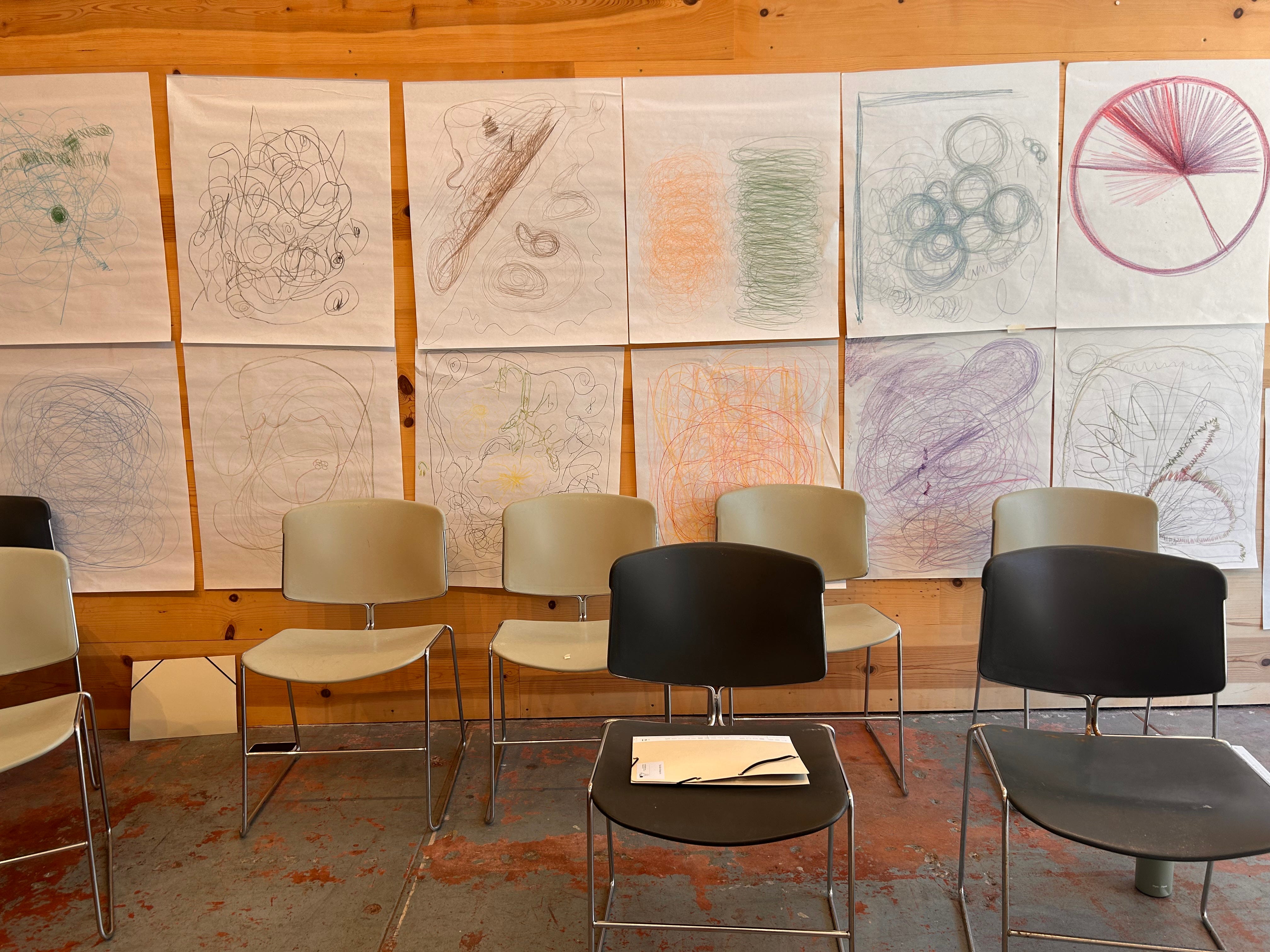
I’m early to an art symposium at the Problem Library, an organization in San Francisco whose meaning is still unclear. Today a small group of people who like art will gather to practice some predefined rituals together. I’m standing outside, looking in, waiting for the earliest session: a tea ceremony, to finish up (late). The two other women standing outside are equally ambivalent (as each other and also as me) about the event. One had a friend who invited her. The other knew the people who were hosting the event. I found it on the internet, like I find everything else.
I was worried about the language of the invitation, which seemed overly precious mixed with an uncomfortable amount of corporate.
Tomorrow we will congregate once again for a day full of programming presented by…students, mentors, collaborators and other friends…all of whom will be sharing how they understand our central theme: ritual, the description of the event read.
Reading it now, I’m thinking it’s so California, and so I guess it’s not a coincidence that after the morning is over, and I’m sitting down for lunch, the two people I sit with know each other from New York. Both women, both designers, both in their mid-thirties. Both very much killing it at their jobs.
When I describe my artist's date mornings, I act like I’m cheery, but I don’t say the truth about why I’m here: my brain is desperate for impossible levels of achievement. I can only function when I remove myself entirely from the product and operate only by process. Everything paralyzes me and so I need a schedule to keep going. Sometimes it’s hard to feel meaning in things.
The prompts, or the exercises, or the “invitations,” as the group called them, were two fold: the first was a drawing practice where two people stood in front of each other with a big piece of paper and just one pencil between them. The second was a movement exercise, also partnered.
For the first we were to find a way to draw together, using one pencil, focusing on different elements of control: how hard to push down on the page, how much does one person lead, how much does the other person follow. There was very little time to discuss the details and so we got thrown into it, me and one other person who had never met, holding onto the same instrument, trying to make something happen.
It was awkward at first until it wasn’t, and we moved together freely—almost using the pencil as an anchor point between us—both of our bodies shifting toward and away from each other as we made wide circles on the page. Before we started we had quickly agreed that the person on the bottom of the pencil would lead and the person holding the top would follow, only that didn’t feel right. I found that while I was the motor, she was the rudder, and I looked very closely at her hand too see what direction it might be leaning toward next.
It was an unusual way to get to know someone, without words, only with movement and art making, and yet I felt when we were done that I knew this person better than I knew some people with whom I’d exchanged a whole lot of words. We did three sets of drawings, all three to ambient music, each time putting our finished work up on the wall with the others. Most of them had some kind of circular pattern, some were more loopy than others, no one made a figurative work at all. After the second round I felt a kind of hubris about the whole thing, like we had done it the best. I saw how our drawing was different, how it had the regular circular pattern and then also had unexpected moments that came out without one person fully dominating the image. It might have been my first experience feeling successful with collaboration. It made me feel connected, at ease, like I lost myself in the work. This is something that’s now easy to do on my own but I find it still almost impossible to do in the presence of others.
“You can do anything,” my partner said to me. “Anything.” Fully, solemnly, unexpectedly. “And I’d be there.”
I felt it was way too confident of a statement. Maybe something she’d said to people before for reasons I can not imagine. Later when I asked her what she meant and why, she referred to one moment, where I broke from our gentle circles and made a kind of crass and harsh back and forth movement at the bottom in a kind of sunburst shape, as an example of something she struggles to do. To break out.
I’ve done this kind of partner work before, most recently at a workshop at ODC where we used a kind of back and forth exercise involving touch to experience both giving and receiving. My partner was unkempt, with unbrushed hair and yellow teeth and I could feel, in her touch, that she knew no difference between these two polar opposites. Her way of touching was clumsy and rough and seemed to be out of touch with me, as the person she was caring for. Likewise, she was not receptive; I could not seem to feel that my touch with her mattered. Instead she seemed to cringe away from any kind of tender feeling I tried to transmit. I was struck by how much someone’s touch can say about them, and how much someone’s receptivity to touch is meaningful too.
The movement piece of this Saturday was different: less satisfying. It was mirror work and oppositional work but I couldn’t get into my body and I felt the way a lot of people feel when they do these kinds of practices: silly, not genuine, going through the motions. Perhaps it was just my partner who was not as much of a match as the first: the person lanky and comfortable moving: perhaps I would have done better to just feel her freedom for the moment and take in her comfort with swaying like a willow tree.
Keep reading with a 7-day free trial
Subscribe to Art Monster to keep reading this post and get 7 days of free access to the full post archives.