

The Knitted Kitty
finishing things and letting them go

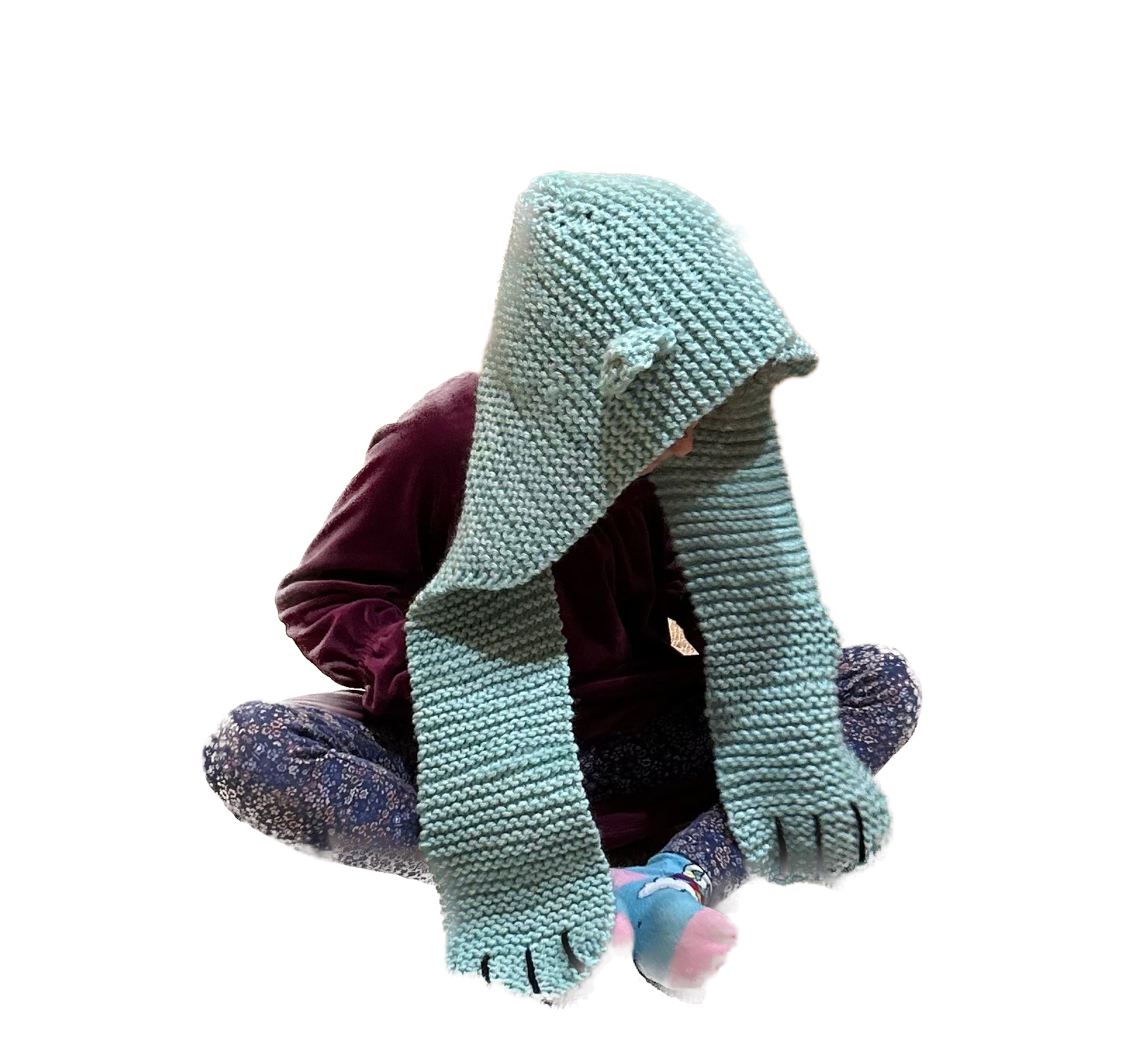
One week into the break, after I had taken the cat to the vet, and gotten him medicine and cleaned out O’s room, and gone to goodwill and made myself steak, we went to the yarn store. We entered with an idea and left with two balls of mint green yarn and some cotton thread and a pattern on Ravelry that would make a scarf into a hood and a hood into a kitty.
“You’re going to be a mint green cat?” asked the person who was helping us, and Olive didn't blink an eye.
The pattern had a nose and some whiskers that were to be embroidered on the hat but Olive was adamant that we not include those, as SHE was the kitty and her face, in the hood, would have both. In short, she had a vision, and I was happy to help.
The beginning went well until I got up to the hood and O realized, before me, that the pattern was created for an adult: the hood was likely to be too wide and the scarf too long if I continued on the way I were going. I kept going for a few rows until I had to agree; we’d have to rework the pattern for a smaller head. I took out about half of the stitches and started again, adjusting for size. Then I started to get fancy. Her regular jacket has a hood and I began to try to match up my knitting shape with the shape of her hood and started to change the pattern, rounding the top, increasing here, decreasing there, until what I had was more like an undulating blob.
“You’ve made it too complicated,” Olive said, looking at the knitting. Oh how it hurt to admit she was right. I pulled it all out and rewound the scan of yarn and started again from the almost beginning.
When I was a kid my mom knitted me things. I grew up in Vermont and I always had matching hats and mittens. I remember a particular pair made from brown and maroon yarn. I remember how the mittens always were attached to each other by a string that had to be threaded through the sleeves of a jacket and how I could always feel both the tremendous effort my mom had made and how different it was to have made that effort and also I remember the feeling of the thin string on my back, tugging slighting and snaking through the sleeves whenever I wore them. Did I see my mom making them? Did I hold onto the effort?
While I knitted the green scarf, O sat with me, in a tiny crevice of couch, and after about an hour of chatting she began free associating about a game of chess, only instead of the chess pieces, there were kittens and unicorns playing against each other, like checkers, and the board was, of course, pink and purple. The kittens, she said, rode on another animal, like the horse of the chess piece and while she talked I just marveled about how cozy it was to be sitting together on a couch, me knitting, her chatting, both of us both engaged but disengaged; grounded but also departed, here but not there. Maybe this was the space of motherhood I’d always longed to inhabit.
None of this explains to me why I struggled so much with the end. The final step was to sew small pieces of braided black cotton onto the end of the scarf to make paws marks on each side. I put this off until, like a cat might have dragged a mouse to the feet of its owner, Olive pulled me toward the scarf with the black yarn in tow. I tried to make the paw marks about twenty times and no matter what I did I could not find a way to attach them. Perhaps I was burnt out. Perhaps I was just working beyond my level of skill. Or perhaps this is what happens to me at the end of EVERYTHING! The very last steps become so small but so excruciatingly difficult because you know what happens when you finish them, right? The thing you made will be done and that’s all the control you have left. You have to let go.
Once I hugged Olive. You let go first, and then I’ll let go, she said and I thought, no, that’s impossible, I’ll never be able to let go first.
Olive went to school proudly wearing her kitty scarf hood on the first day back after break. She asked whether I’d like her to brag that I had made it for her. I think I said sure but I was not expecting that when I picked her up she would have had orders. Six orders, I think it was, one for a snow leopard, one for a pig, another for a turtle, and at least three for a dog. I didn’t and still don’t know whether to be happy about this. My leaning into the the quiet of parenthood for a vacation when there wasn’t much else to lean into resulted in a strong affirmation that my vocation ought to be, not writing, not content creation, not strategic consulting, not project development or editing or team building or management, but the continuous tying of one knot after another, the satisfaction of children who believe wholeheartedly in becoming an animal and the continuous motion of a person who gets knit into the seams.
We went back to that store again, and got a project for Olive: a ball of maroon yarn she wanted to finger knit. In the evenings, while she worked, I made pretend kitty cash and paid her for a long strand of knots that she worked on herself. As the week progressed, I checked in on my order for the fanciest scarf in the history of London and made pretend calls to my friends in front of the proprietor of the Knitted Kitty to tell them all about the most delicious shop in the center of the city that I hoped they would keep secret until my scarf was done and delivered. And on the final day, when it was complete, she wore that scarf to school, leaving the kitty scarf hood behind, forgetting my commission, my hard work to pretend and leaving our trip to the store in past. All of it wound up around her body now.