

Making a Living with Murakami
Novels, Heaven and the problem with schools

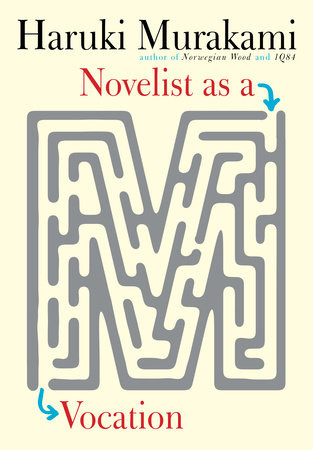
I used to love Murakami and have read most of his books. For a long time I enjoyed the way he captured simple needs: a way of being in the world with a cat and a bowl of rice and some way of connecting to the supernatural. His book are all about being a writer without talking about writing.
His recent book, Novelist as a Vocation talks about being a novelist without talking much about books, save for the one chapter on process about how much time he dedicates to rewriting (a lot!). And also his wife and how she (like an old stove!) is his first and most reliable reader. He also spends a lot of time talking about the Akutagawa prize. I guess he never got it, and that was in some way the end of the beginning of a serious literary career for the guy. He writes a whole section about how it didn’t bother him at all to not be awarded the most important prize in his country. I felt for him in this section because to write like Akutagawa is to write yourself to a point of suicide. I also wouldn’t mind being not awarded for that.
There’s not a whole lot I love about Murakami anymore. There was that one book about friendships that turned into a book about a threesome that turned my stomach. I am not the first or the last to note his sexism. He even notes it himself. The one thing in common his readers have is that “the women are all beautiful.” He said that. You can see how this could get turned around on you if you tried to point it out.
The student of a writing teacher who works at Dog Eared Books in the mission shared my growing dislike. As I was checking out with a copy of Heaven, by Mieko Kawakami, the cashier / writer / writing teacher told me that when he had tried to put Murakami on his reading list for class a student had written him a one page letter about why Mieko Kawakami should be there instead. One wonders why there needs to be just one Japanese writer, but that’s a separate topic. She was making the argument that Mieko should replace Murakami and the person checking me out said he read Heaven in one night, which is about how much time I had, before he agreed.

The book is about bullying in school and a friendship that gets formed between two students who get the worst of the violence. It’s about whether you can make sense out of something that is that meaningless by agreeing with its meaninglessness or if you try to fight back. How can you fight something that’s nothing? That’s the hold violence has over us. It’s about whether the whole nothingness often summoned in Murakami’s writing isn’t just a response to the violence in Japanese culture which is hard to make sense of without dissociating.
Here’s another thing that doesn’t make sense. Around this time when I bought and read Heaven Olive got a medical diagnosis for her eyes. It turns out she can’t see very well through her left one and after years of not having glasses it’s turned to a more complex problem called Amblyopia. Naming things is important. I almost passed out in the optometrist’s office when I got the news.
On page, I don’t know, let’s call it three, of Heaven, the main character reveals that he has a lazy eye. The end of the book (spoiler) is incredible and answers a lot of questions we all have about when one bad event takes us to a place where healing can occur. In this case, a bullying episode takes our main character to a hospital where he learns that he can have a surgery for a second time to turn his lazy eye back out. In doing this he has to sever the friendship that was created and maintained on the basis of a shared understanding that nothing means anything and that their joint survival was dependent on that.
Does it mean anything that the book I randomly picked up at the bookstore, without knowing one lick about it, had a plot line exactly the same as the plot line in my current life (save the friendship)?
“It makes a big difference,” Olive said, when she put on her glasses for the first time and my heart broke into a million pieces. You can bet I wrote a whole lot of emails after that. Some were to the pediatrician and others were to the principle and another to her new teacher who should probably know. Was it defiance that her past teacher had experienced when Olive had refused to write letters? Or just that she could not adequately see the page?
The best section of Murakami’s book was not about writing but about education. School, he says, should be a space for individual recovery. Few reviews mention this part of his book perhaps because it diverts from the topic of writing so completely but I thought it was the most striking. He basically argues that school should have an entirely different purpose than it currently serves. That he came to this conclusion is not as surprising as the fact that we, collectively, have not.
“You may be too identified with her,” my therapist has said about Olive and her near hatred of going to school ever since the task began to be equated with progress. But in this book Murakami gives a real vision of what makes a place where solutions can be found.
“It would be a place where the individual and the larger system can each move freely and gently interact and negotiate with one another. In other words, a place where each person can freely stretch out their arms and legs and take a good long breath. A place apart from hierarchy, efficiency, and bullying. Simply put, a warm, temporary shelter.”