

LIARS BY SARAH MANGUSO
A very messy book review

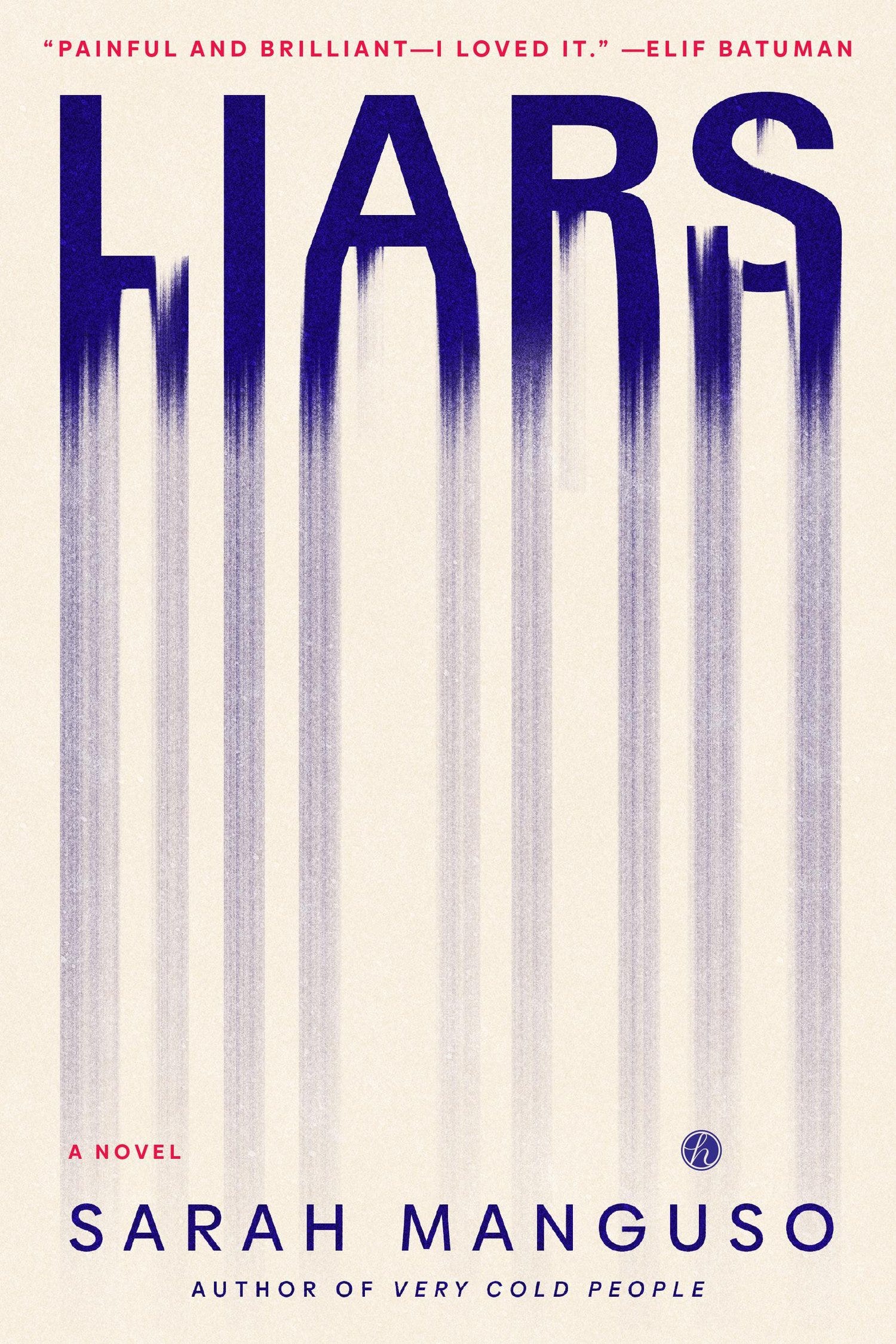
Sarah Manguso’s novel Liars tracks the internal life of a woman whose husband is a jerk for a long time and then leaves her for another woman. The first two thirds of the book is devoted to the mundane details of an inequitable marriage in ways that have been written about for decades but perhaps not so succinctly, simply and resonantly. It’s the story of how women become the unpaid or underpaid employees of a family which they envisioned and created and the cogitate dissonance it takes to uphold the two things together: I wanted this thing that is terrible for me.
The basic narrative is one of the couple fucking just enough and things not going well with his job, punctuated by paragraphs like this:
…I got a library card and took out some picture books, bought bananas so we could bake muffins, unpacked a couple of wardrobe boxes, did a load of laundry and accepted a small editing job.
or this:
John built four raised beds and plated tomatoes, strawberries, peppers, cucumbers, zucchini and herbs. He constructed a hydration system that worked poorly and cost hundreds of dollars to assemble.
or this:
John and I both caught the child’s cold. John stayed in bed for two days; I took the new kitten to the vet and bought groceries and did dishes and laundry and planned all the meals and took the child to school and so on. I took one nap but otherwise kept everything up. And that is a mother’s cold.
There are whole Instagram accounts dedicated to jokes about under functioning husband with hashtags like #wifeproblems. Which strikes me as the equivalent of Trump being called “weird,” when he is actually dangerous—as Nancy Pelosi said this weekend in the NY Times. Instead, there has come to be a kind of cultural charm around the types of anecdotes where women get the short end of the stick over and over until they have nothing left to live with.
Liars is also about the way the narrator normalizes it within herself by writing and then rewriting different versions of her family’s story. She tries over and over with slightly different narrative archs that never feel resolved no matter how many times she writes them. That’s also, it turns out, a part of the job description of #wifelife: to write yourself into a story in which you’ve been cast as an extra. It makes no sense no matter how often you spin it. You might get frustrated but if you are especially hard working you keep at it, turning it around and around, trying to find an angle from which it makes any sense for you to have taken the role.
I told the story again as if it wasn’t a big deal: We moved from LA to the Bay for John’s job. Nice months later he was fired. Four months after that we went broke.
and then later:
I wrote down the story of my life again: “Managing the household falls entirely to me, since John works full-time and travels frequently, so I teach part-time and spend my days trying to fit ten points of shit into the proverbial five-pound bag. I long for a bigger bag or less hit; it’s been more than six years since the child was born, and I still feel surprised and confused.”
I super related to this moment of being the parent of a six year old who some days seems to have made no progress since they were born, because early childhood isn’t a product but nobody tells you that because then who be willing to manage it all?
Their child is referred to as “the child,” and has a light presence in the book, often delivering light but poignant statements that show the impact the narrator’s devotion to mothering has had on him as well as the way the divorce breaks his heart.
The little tiger pin I’d ordered arrived, beautifully wrapped. “I never knew I’d want a pin so much,” the child said, minutes after opening it. And that was the blazing star of the day.
I love it, he said, when I tucked him into bed.
When the child turns eight, Manguso writes that “interminable toddler years” are over with an honesty that I feel is so rarely granted. When school and activities kick in, time changes almost overnight from a daily grind to a life with a tremendous amount of freedom in comparison to the early years. It’s a strange feeling that can make all the work of early development seem as if it was done by someone else—some sacrificial “mother” character that you can no longer relate to yourself—and yet somehow she raised this human who is still not only alive but in a number of ways thriving.
Olive is now eight. Next year there will be swimming on Mondays and dance on Tuesday and Thursdays and on Wednesdays there is chorus. She started piano in January and so that lesson is slated to be on Friday. Just two years ago I spent those 25 hours a week with her, one on one, aside from the regular responsibilities of getting her ready for school and putting her to bed at night, which frankly are impossible tasks in conjunction with each other. Now she’s “adjusted,” and so these two distinctly different places: home and school, private and public, make some kind of sense to her. The freedom of that seamless transition which seemed near impossible to make, has made life a million times easier. It’s no coincidence that John leaves the narrator when their child is eight. This is when you would finally be entitled to celebrate.
“I felt more saturated with love for the child with every passing week, my capacity for it growing huger than I thought possible,” she says as the book nears its end.
This is both the told and the untold story of motherhood in one sentence and also the lied embedded it that story. This love is the gift that you get when you are willing to make all the sacrifices, rather than love being the reward for just being willing to change.
The cat in the book and its death is no small matter, which is crazy to say given that the main storyline is about a man who leaves with his wife without discussion after having had a long affair that he hid from everyone. That ought to have been the most painful part. But no, it was reading about how many times she took her cat to the vet and how many times she found cat vomit in her house that was left for her to clean up and how desperately the cat needed her attention because there is literally no one else to help him get well.
I couldn’t tell if the urge was entirely separate from my habit of locating any nearby need for emotional labor and immediately fulfilling it, but it didn’t matter, she writes of herself in one of many moments of reflection.
I owe myself a separate essay about our cat but when O asked whether we could have another pet soon after he died and her dad said that we could, I immediately shut it down and said that I was not willing to be the sole owner of the family pet all over again so soon and possibly never. No one stepped up to the plate.
The last third of the book is much more important and much harder to write about. We’ll go to therapy, she says when her husband says he’s leaving her. In the last part of the book the narrator goes back and sees how their marriage and the man she had made him out to be were created entirely out of her own imagination and how she would have to take responsibility for that too.
“I closed my eyes and gathered the entire marriage into a pile. It looked like a scene from a building demolition, rebar and jagged wood, half a lifetime’s worth of stuff. Then I compacted it and the pile contracted, crushed by heat machines. When I was done, it was black as coal and had the density of a collapsed star. I opened my eyes.”
What Liars made crystal clear to me is that it’s not the doing the things that’s the problem. It’s the insistence that they be done invisibly. It’s crazy that we’ve called this invisible labor, as if it’s hard to see, rather than just plain denied. The expectation is that the #wife does everything as a FAIRY might do them, with a dress and a wand and an ability to be anywhere anytime looking both old and beautiful, wise and trustworthy, matronly and still womanly, and we want to be that fairy. Then we hide our human sides who might sometimes love the work and might sometimes not love it and might sometimes fail at it and need emotional support just like an employee of any high stress job that requires a high cognitive load as well as an insane amount of mundane tasks forced into a non-negotiable amount of time that is never enough. Only we don’t have our own wives for that.
The third sitter arrived with a bag of her son’s old toys. She brought the child to a play date with her friends and their own tiny charges. They had a picnic at the park and the child came home asleep. In her last few minutes, she did dishes and tied up the toy. I sat down for the longest I’d sat down in months and watched her save my life.
I mentioned to Celeste while she was over and I was making us Sohla El-Waylly’s now famous chicken, how I feel forced to live on the margins of my own life - an idea I felt with confusion when I was on a solo trip to Mendocino last year. On that trip I stuffed in as much as I possibly could in two days and felt alive and well and wondered why this feeling was only possible when I was by myself.
I could not fully inhabit the life that I lived most of the time and it was because my family needed me so much of the time. But what was my family without all of me actually in it? Instead I live my full self in slivers, inhaled like a drug, going from yoga practice to lunch by the sea to eating blackberries to a waterfall hike to a belly dancing session at the community church to coffee in the morning, in my small number of vacation days, as if I could store up these parts of myself like water in a camel’s hump. When I try to push myself into the container of the family it threatens to break into pieces from the weight of it.
We often talk about how women are demanding so much of their partners these days, expecting husbands to be lovers, and friends, and dads, and good housemates, and how that’s impossible for any one person to be everything. I think that story fits in too closely with the narrative that women ask for too much for themselves–how we want it all. One person does not have to SATISFY all of these parts of us but they ought to be able to survive knowing they’re there.
The inequitable division of labor has been a topic for feminist literature since the beginning. Plenty of writing breaks down the financial consequences of this kind of relationship. Trauma specialists will talk about it in terms of abuse and exiting and recovering as a matter of individual fortitude. But the sheer familiarity of the story, as Manguso writes it, is what makes it so powerful to read. We know that it is wrong but we act like it’s normal. It’s finding new words for this story that feels impossible to do.