

how to face disappointment
on looking your past straight in the eye

In the week leading up to the personal essay critique in Jensen Beach’s MFA prep class, I began to feel very nervous and anxious, which, he reassured us, when we got on the call, was normal. Most applicants go through all kinds of second guessing at this point in the process and imposter syndrome was par for the course. He seemed to suggest that these emotions would pass, but a part of me doubted his expertise on the matter. This was the kind of fear I’d always been running from and now it was back.
While I was writing, Olive came into the room and said: “Do you know where the kids spoon is because it’s nor to be seen.” This delights me and terrifies me. We are so strange, she and I both. This is the kind of relationship to language that I love for her but hate for me. I know that to hide it myself means that she will develop some level of shame. Of course I do not want that for her.
As we began the critique, I started to sweat and told the class that, in drafting a personal statement I had begun to think maybe I didn’t know who I was, that maybe there was no I to write about at all. I was unraveling in front of everyone, and they seemed maybe surprised? I think I had held up a good front until now.
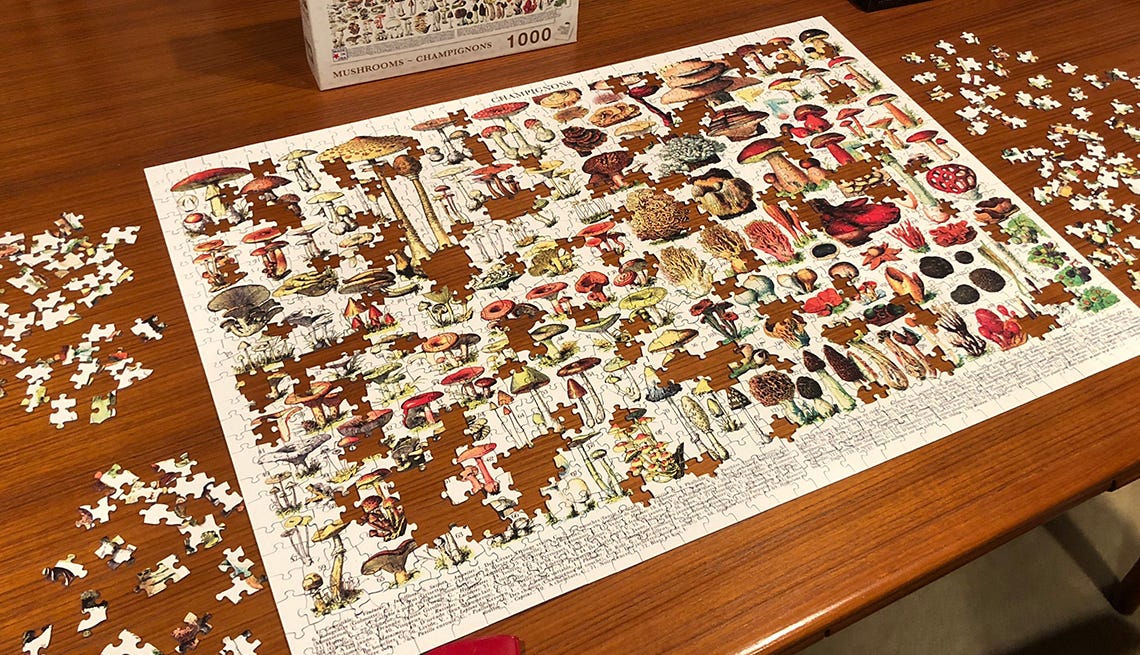
Jensen, again, brought the chill and asked us to imagine doing a puzzle, which, he suggested could be used as a metaphor for piecing together parts of our selves.
Start with the edges, he said practically, and then fill in the rest in.
You know, I said, I don’t want to tell you this but, but I don’t do jigsaw puzzles that way; I never start with the frame.
No!? He exclaimed, then what do you do!
I breathed in and then said that I grouped together like-minded colors and patterns - you know, found the emotional qualities of the pieces. I sighed, the class oohed, and said, well that explains everything about you, that just right there.
Some people call this dyslexic.
Be careful of mentioning too many project, one classmate wrote, so as not to look unfocused, said I knew she was right.
See if you can tie these disparate parts of your life together and bring the essay to point them toward this path, in conclusion, said another classmate who I admire. My life, though, I felt, had no such through line. I was not alone in this - other people in the class felt this way too.
Just don’t, said Jensen, write about how your third grade teacher told you that you were a good writer. Jesus Christ, but it was true. Mrs. Vreeland used to have us all write journals, which she would read, in marble notebooks and she’d return our words with letters of her own, in her handwriting, in some other color ink. Nice work, this is good! And I had taken it to heart. Not that I thought in third grade that I’d want to write for my life, but it had made an impression, writing did feel like a way to be seen.
Jensen told us about his own 5th grade teacher and I won’t share his story but it made mention of a flute and a 20 minute writing exercise that even grown-ups now might be challenged to do. I don’t doubt that he killed it, even back then, - and it trigged my own memory of 5th grade and the little reading group I was in that sidetracked a group of us falling behind. That year Mr. Baldino introduced us to the Lion Witch and the Wardrobe and I think, were it not for that text, I would never have wanted to read a book to the end. These fantastical tales gave me reason to get over my reading difficulties; I would do whatever it took to get into those worlds.
I’ll still go through the application process. But this beautiful essay about writing by Jet T, in her newsletter Tiny Violences, this week got me to thinking about a very real fear: that the act of wanting this one thing might take me away from another, and those things I’m already doing quite well. Trying to write in professionally has a way of making you feel like you’re nothing. Before, when your experience is abstract, it can start to mean everything. But not once you put it down on the page.
Alexander Chee wrote about (what feels like the inevitable) submission of your admission materials into workshop in ‘How to Write an Autobiographical Novel’, and the disappointment us writers who attend writing programs feel when the object of our intellectual and traumatic afflictions converges on to the page and are met with a meh. What had once been a source of pride just became another essay. I hadn’t met disappointment this way before.
This kind of disappointment reminds me of another kind of disappointment and they are both of them happening at the same time. I’m handing my kid over to the world. It is so sad.
Did you put away that dress, because it’s more for a younger person? Olive asked,
Maybe I said.
Yeah, you’re like more like a grandmother now, she said. You have gray hair and also more freckles. I’ve been noticing that.
As I tried on some clothes, that I bought for a reading, she said: “You look good, like a man, like you’re going to work. Also, because of your short hair.”
About a dress that I haven’t worn because, god, with what bra, she said: “That looks nice mom! You should wear that more often!” And she crunched up her face when I tried on a jacket overtop. “Why are you putting that on,” she asked, and she showed her disapproval by leaving the room.
The lens turns so fast, nobody tells you.