

HOW TO BECOME
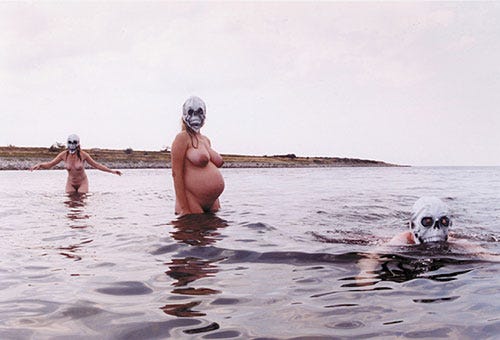
One Piece #3: Hanna Liden, Untitled, 2002

The opening of Hannah Liden’s show at Rivington Arms in 2004 was a madhouse. All kinds of beautiful people spilled out of the space onto the streets, and the sidewalk became like an outdoor bar, complete with red buckets filled with Pabst Blue Ribbon and ice. The cops were there by 7 pm, and everyone got rushed away. I only know this because I read about it in Art Forum this year, when I was at work writing a novel about an art critic who fell in love with an artist. I just moved my desire for this work onto a person who remained mysterious in all these same ways as Liden’s work — dark, erotic, beckoning — only to slide back into the lake as soon as I tiptoed in.
That year, I was still living in the smallest apartment known to mankind - a sixth-floor walkup where the living room was the same as the kitchen and the dining room, and the other two rooms sat in the same square divided by only a wall. It was the closet I loved best about the place, which was long and had shelves, and it was there I started amassing my collection of used books from the Strand. From upstairs, you could smell the pizza place on the ground level, a mixture of dough and tomatoes at all times of day. I was young, broke, and by no means a part of the art world. I was a waitress, and I spent my days squeezing orange juice and getting abused by a chef.
All the images in the whole show – and her shadow death – were striking. There were familiar objects: black cloaks, gray sky, dry, scratchy grass, you can just hear the grass rustle, the camera shifting around, and the sound of someone breathing while they run away. In the photos, there were rocky cliffs, grave markings, and a reaper holding a flag made of flames. Solitary figures were walking at the edge of the smoothest mirror of the lake, while some kind of blaze lit the edge of the frame as if the physical photo was on fire.
But the one image in particular made me stop short.
A pregnant woman stands in shallow water, not near the land. The sky is slate gray, so you knew the water was cold. She stares through a skull mask directly at the camera from the near center of the photo, and though her body is tilted, showing the curve of one shoulder and the line of her chest, she’s looking dead on. I can feel the cold water slicing halfway up her thigh.
In front of her, another person is swimming, her mask’s upper teeth just grazing the surface. Behind her, another woman with a mask walks in with more caution but still leans her chest toward the water, like you know she would do it. The water sliced up her legs, too, and a shadow of darkness shimmered below them both.
I was twenty-five. I didn’t want to have kids. The masks were the same gray as the sky, and a thin strip of barren land in the background contrasted with their naked bodies. These women held the richness that I’d always been after. This photo, as soon as I saw it, became my escape plan, and I don’t even know what I meant by that feeling. I just knew that whatever it was these skulls were suggesting, they were speaking and offering that thing directly to me. No matter how dark that water was, I wanted in.
It’s not motherhood she’s talking about, not literally anyway. I think it’s creativity combined with the truths of the body, which is the most deadly combo. At the same time, she doled out a warning: beware that if you swim in these waters, you will never again be able to show your true face. You don’t need to be a woman or a mother or pregnant to get to this point. But if you are any of these, you eventually will.
This is the paradox about motherhood and artistry that people so often miss. Birth is so ugly and misshapen and miraculous, too. Then we’re set up with this fantasy of what it all should look like from the outside, that it should all feel monumental. From the beginning, we’re asked to clean up the mess of the birth and then host our in-laws. No one tells you about the mesh panties. Or maybe one person did. The undoing of the body, the pre-baby body as the desired recovery, the way that carpools and family dinners and doctor’s appointments are supposed to be done with the tidy up energy, like you hadn’t bled.
I remember after my daughter’s birth, my doctor came to my bed, literally bedside, and said: Let’s just forget about this “bad placenta business,” as if he hadn’t just ruined the best day of my life. As if that business hadn’t filled his own pockets. Before that moment, denial wasn’t my water. That’s not where I swam. I truly had this fantasy about womanhood, the one in this photo. That becoming meant something ancient, something ritualistic, that it meant something taking you in.
Or maybe this image speaks to something subterranean. How far under you need to go as a woman artist to get to a place where it’s safe to hear what you’re trying to say, to see what you’ve actually seen? You have to go so far out - to the last strip of land, to the coldest still water, to take off your clothing, to hide your face in a skull. Only then are you really allowed to remember that you were made by a woman, the whole of you grew inside her. Why then do we project onto men all our creative desires?
Oh, the rage. How we displace it over and over until it walks alongside us, two versions of the same person instead of a mask. These women, in the water, that’s how they stay warm.
Beautiful… also what a memory: Rivington Arms in the early aughts!