

HOME HAUNTING
One Piece #4: Site-Specific work at Headlands Center for the Arts

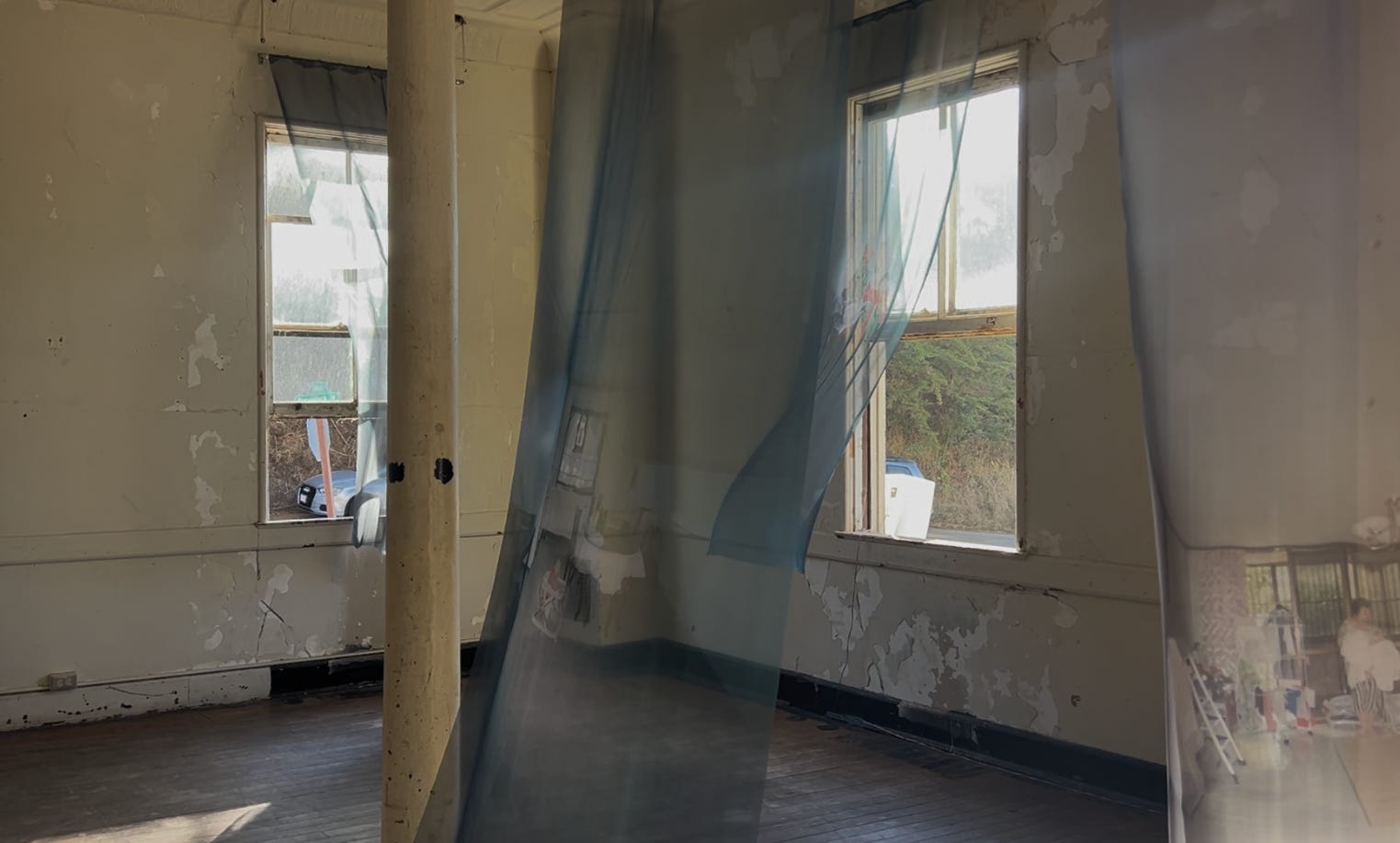
This week I’ll discuss this beautiful work by Heesoo Kwon and her two collaborators, Sso-Rha Kang and Andrew Sugntaek.
I was meeting a friend at the Marin Headlands Center for the Arts for their open studios. The public event takes place a few times a year. I missed it last year. My daughter was sick, and so this same friend went without me but suggested we try again, a year later, to go together.
In one building are lectures and installations, and in the other are MFA fellows’ workrooms available for visitors to peek in and chat. Writers, illustrators, and film editors take up residence in the smaller rooms while painters and product makers use the big spaces with great light on either side of the building. The gymnasium was closed last year, but this year it was open and used for performance. All of the structures are old military buildings that have been refurbished into project spaces, dining areas, and lecture halls with a wide open, minimalist feel. The whole thing is outstanding, beautiful, and serene in every way.
I was standing outside waiting for my friend to arrive when I saw a thin slip of fabric billow out of a window. The sheer material ran out of the opening and rolled around in the gentle breeze. The fabric was a shade of dark blue, and I could see that there were figures that had been printed digitally on top of the curtain. Right away, I noticed how delicate it was, how the figures were translucent and barely there, how they rode the wind.
The site-specific installation it belonged to was on the second floor of the main building, so I went up before my friend arrived.
The mostly open room had large windows on three sides, and each window was covered with printed material, see-through, and layered with faint photographic images of people set in the center. The windows were all open, and so each one had movement at different moments, and on this warm November day, just after Halloween, they felt like hauntings, or spirit figures, without bodies but with enough presence that you knew they were there.
In the center of the room were rice cookers on a triangle-shaped table, each stuffed with a speaker that amplified sounds of what might be a family kitchen. It was so evocative — this combination of material, photography, sound, real objects, and spatial ingredients. Without any sign of more standard art practices like, let’s say, “painting,” or “drawing,” the three artists created a feeling of what they described as “what once was or could have been.” There was a yearning.
When my friend arrived, I rushed upstairs with her to show her the room. She was also into the work, and it was actually with her that I noticed the sounds were coming from inside the cookers. We noticed that they were each hooked up to an audio mixer, and then as we got closer to the structures, we saw that the mesh material in each was actually speakers. Before that, the sound of children’s chatter, the clatter of dishes, some pitter-patter of feet was drifting around — like an echo, or a wish, or some mix of both – and felt as if it could have been coming from anywhere, maybe even the past.
It felt good to be in the middle of the room with the artwork surrounding us, rather than as sometimes happens with big installations, where all the art dominates the center of the room, and you get kind of displaced. With the artwork on the windows, the work incorporates you into it, which is definitely in line with Heesoo Kwon’s practice.
Leymusoom, as referenced in the title of this piece, is a fictional religion created by Kwon, which she has envisioned as both autobiographical and feminist. Her commitment is to rehistorize her female ancestors into new timelines and with cultural boundaries, as well as to convert new members into its ranks.
The religion is part of the title of many of her works. In a workshop called Leymusoom School, the artist and her collaborators guided participants in the dismantling and reconstruction of their own histories. In an exhibition called Mago Leymusoom, the artist reinvigorated the mythology of Magohalmi (마고할미 or Mago 마고) by using her own body. In each case, there’s a recognition of loss — in the first, of histories you might have wanted for yourself but never had, and in the second, the lost history of a feminist icon — before there is a reconstruction, or a making anew.
So this work is as theoretical as it is embodied and as personal as it is communal. It’s also highly digital, so flat portraits from family photos are turned into 3D models, which are then animated and become part of the artist’s current utopia. She knows the work is the work of fantasy and also that she feels entitled to it: to a world that’s generated in a mixed media way, in which women’s bodies conjure power, community, sexuality, family, friendship, all in one breath.
I didn’t have this context when I saw the installation but it made sense to me when I remembered it after: how her video work I’d missed earlier in the Fall was linked in process to these photos and how the blue fabric on the windows reminded me of my own domestic and maternal fantasies — in my case quite literally some sheer blue curtain, printed with flowers, that I’d never fully installed. I’d found them at a yard sale in Brooklyn when I first moved into a brownstone, and I’d slung them over a curtain rod a few times, always loving the way the light came right through. So impractical, but they were also kitchen-like to me: some kind of farm, some kind of wooden bowls with garden ingredients, and always a gentle breeze, so critical to these female mythologies.
As my friend and I walked through the buildings, we continued a cadence of checking in: did we want to stay longer here, did we want to skip there? Were we hungry, did we care about the performance, could we do the lecture, did we need to sit down and rest? Was the body in the gymnasium the artist who created the piece? Was the piece anti-zionist? Did she know what was for dinner? Did her kids eat her dinner? Was a kid who had a lemonade stand an entrepreneur? All of these topics seamlessly slipping in and out of each other, between walls made of paint and also projections
Like the way it might with a family.
It struck me then that what I felt in the installation was a familiar romantic longing, but for family instead of a love relationship. How quickly those feelings can be summoned: even with clips of digital families with different cultural signposts (the rice cookers) or in children chattering in a different language. It’s like you know that thing even if you’ve never known it firsthand yourself. This work captured how powerful that hunger is, but also how fleeting, how it could blow out the window at any moment. The textures it’s made of so delicate and even sometimes made up from scrapbooks of memories, pulled together for one day. How you can feel its importance and its vulnerability all at once.
This is a new work about this topic: addressing mythology by way of fantasy and addressing belonging by way of personal history, and addressing possibility by way of fiction. Kwon is creating a whole corpus of work and a continuous movement to set the stage for a new kind of living, where the body means more about what gets born from it than what labor it does.
Leymusoom Firefly, 2025, Irwon-dong, windows, 1991–1994
Curated by Sso-Rha Kang
4-channel rice cooker speaker system by Andrew Sungtaek
Inkjet prints on silk and sound piece by Heesoo Kwon
Leymusoom Giftshop by Sming Sming Books