

Feminist Fridays: I love you but get the f*ck off
Thoughts on Amanda Montei's new book

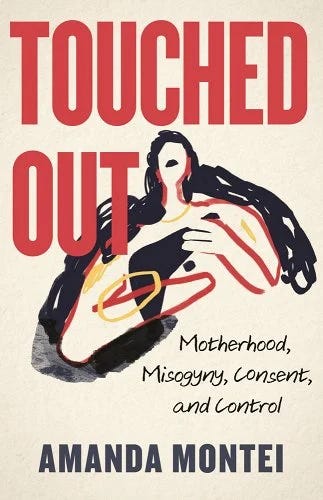
I owe a big thanks to Amanda Montei, of Mad Woman, this week, for giving me permission to kick O out of my bedroom in the middle of the night. Actually, first she kicked me. She does this thing for comfort where she pushes her feet into my body in the exact place that my body often hurts (my lower back) and sometimes it’s hard enough that it’s painful. When the kicks became especially rough the other night I said “NO, no, you can not kick me. That hurts.” And maybe I’ve said it before but this time I meant it and she gathered up her pillow and blanket, after trotting into my room at 2am, and dragged them back to her room next door and stayed there all night. When have I felt so justified to say no when my physical limits have been reached? Probably never.
The topic of Montei’s new memoirish-with-a-twist book, Touched Out, is motherhood and consent and she asks whether the sacrificial nature of motherhood isn’t tied to our own histories of accepting unacceptable touch, of not knowing our own limits or rather of knowing them and knowing that to say them out loud is to receive shame, blame, gaslighting and often flat out denial. Sometimes we’re told that we didn’t make sense. In short the training for motherhood begins when we are trained in girlhood, to fulfill expectations, and while a long history of feminist texts have told us that — many of which are noted throughout the book — the experience of the physicality of motherhood has often been overlooked. And how conveniently so! If we just deny women sexual agency their whole lives and make them receptacles for other people’s needs then surely a woman’s happiness and satisfaction as a benchmark for success won’t leak into motherhood, in any regard.
Our bodies know the paradox of this sentiment, I think. Why is a person’s body so poorly cared for before pregnancy, during pregnancy and after childbirth when that same body is ALSO expected to be in charge of that child’s body throughout their lives? Women in heterosexual relationships are more likely to be the parent to get the kid’s body back and forth to school, to make the doctor’s appointments, to follow the pediatrician’s advice, to administer medications to sometimes non-consenting children, to buy their clothes, to hold their heads up at night when they are sick, to bathe them, to feed them…the list of physical, body oriented needs goes on. If we are not receiving care in our lives or in charge of our own bodies how can we be expected to be of service to another person’s body effectively? I don’t think I’m alone in saying that I actually LOVE providing all of these things for O; it IS why I wanted to mother; I AM interested in the body and all it entails but when culture, our relationships, and our own self intimacy refuses to acknowledge our innermost needs, we just can’t do this job with well for sustained periods without some resentment. And that should make sense.
AND ALSO WHAT ABOUT PLEASURE?
I have a friend, K, who was telling me about how good the touch of her kid feels to her and although a hug from her husband feels good, it does not compare to the hug of her son.
After she told me this I told her that sometimes Olive ruffles my hair. Each time she does I’m shocked by the impulse. What is she feeling at this moment? It almost happens like a kind of afterthought, like a kind of physical musing, like a passing cloud on a good picnic day, just like the wind. It has shocked me to see how hard it is to receive this nice touch as a reflection of intimacy. My other friend, Jen, once sent me a picture of her toddler brushing her (my friend Jen’s) hair and I almost died. I think to see any success in parenting of the most minimal kind is such a relief. Thank god this body I made has internalized safety.
After K and I talked I took O to the playground with a bunch of other kids from school and she was hiding out in the bushes with some kids and this one girl who I know that she likes kept calling out for her.
“Olive,” I yelled as if the playground was our backyard, “I want to chat with you about something. Come down to the bench when you can.’ She came scurrying down shortly after (and I swear this kid NEVER listens to me without a thousand reminders) so this was a moment.
“I know you were excited to see N and N’s here and I just wanted to tell you she was asking to play with you.”
I was kneeling down to her height while I was telling her this and she had her hands on my shoulders and as I was talking she was inexplicably soothing me with her hands on my arms, running them up and down softly. I noticed it as she was doing it and as she was saying she wanted to play with the kids she was playing with and I noticed it felt good and that good feeling meant everything.
The miracle end of co-sleeping didn’t last forever. She was back in there last night — and I shifted around to the bottom of the bed to avoid her feet which constantly seek my soft body. Thinking through this book did, though, give me some clues about what had been happening all this time: why I had been co-sleeping still when I didn’t really want to be — or didn’t want to be most of the time. In fact, the biggest beef at our house since I had O was about our bed and who gets to sleep in it. For years my partner has wanted to demand that our daughter sleep in her own bed and all through the night and it is not as if I didn’t not want that to be true too. It was more that she clung to me in a way that could not be changed by my pure will alone. I tried to explain that in most marriages the male partner helped with the separation and slept with the kid but he would have none of it. This was a job I needed to do and I needed to do it myself.
And therein lies the rub. My daughter needed to sleep with me BECAUSE I was exhausted and unsupported and mostly alone with it all. But also because my RESPONSE to that feeling was resignation. I just assumed that the best case scenario was that it was just me and her and at the very least we would both get some sleep. I thought the best we could both do was just accept that this was the way that it was. But I can thank Amanda this week by saying, a big fat NO to that. Motherhood as full sacrifice of one’s own pleasure may be normalized but that doesn’t make it right. Acknowledging that is the very first step.
What a pleasure to read this reflection, Emily, especially after just encountering a horrible Repub take on one of my essays in The Federalist! It’s such an honor to have the book seen this way. I just love the way you are writing about the deep pleasures of parenting, those brief tender moments we share with kids, and the way those moments get tangled with OTHER STUFF. I’m so glad the book helped you unravel some of those knots. Thank you for this.