

FATHER FIGURE
Artist's Date #40: San Jose Museums

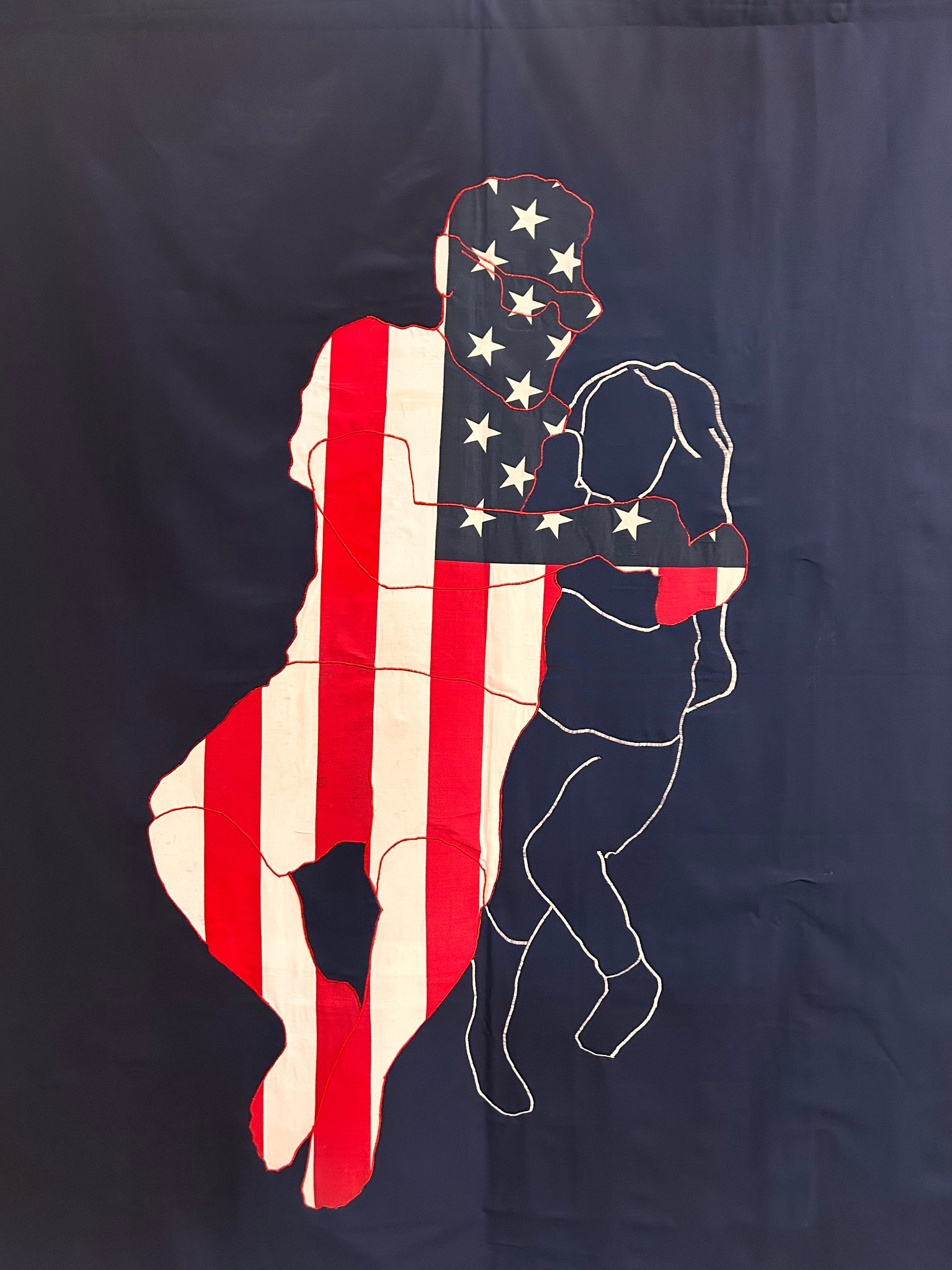
This image holds a story that might make you mad. It was Arleene Correa Valencia’s story which, as she told it, is made up of the fabric of America.
I just bought my own house, she said to the group, in front of a body of work made of family photos, at the Institute of Contemporary Art in San Jose. So I’ve achieved the “American dream.” But because she was still undocumented at the time of the sale, her husband’s name is on the deed to the house instead of hers or both of theirs. It doesn’t matter, she said, that I put down the down payment. It was clear what she was pointing out that all her efforts had made someone else the legal owner of property which ought to be hers. The way she said it was so matter of fact, as if she had come to accept that this is the way things are. Which wasn’t the same as being complacent.
When they first moved into their new house in Napa, an area she said she found as beautiful as it is loaded with this history of migrant labor, they found this American flag in the garage. At first, she said she wanted to destroy it. Fuck this flag, she’d said to her husband who told her, maybe for better and maybe for worse, to settle down. She settled. She folded up the flag and waited until she found use for it - this piece that depicts her father filled in with the stripes and the stars, and her as a little girl, waiting to be reunited with him.
In her talk she spoke of the letters her own father had saved in a ziplock bag, but had never told her about until she found them. In them her mom wrote over and over again about how she wanted to know when to leave Mexico and join him in America and that the kids missed him and longed to see their father. They did join him eventually although she feels guilty that unlike her, he can not go back home. In Napa she teaches art to children in her studio on the weekends and works with older people who might need help with something as simple as printing a document. She distinguished this work as the work that, in contrast to her artwork, was the kind that made a difference.
Another artist at the institute talked about his mixed heritage and his own adoption which he didn’t know about until he was 23. His name was Demetri Broxton and his piece was a boxing robe and a pair of gloves covered with shells. He didn’t talk at all about gender, but I wanted to ask him about masculinity and violence. These objects seemed to be usually one thing: a thin cover to a muscular body or thick puffy material to cushion a punch, but he made them into something else more ornate. Was the ornateness feminine? Did the shells and photos and writing on the objects make them into something more layered and complex? Is masculinity actually the one-dimensional thing we ask it to be?
He talked about how boxing was the first American place a black man could hit a white man without worrying about being lynched. He had been raised in a household of strong women and so perhaps he didn’t feel as conflicted about gender as much as he knew what racism had done to his past. Photos of relatives he’d never met hung from the robes as a testimony to a lineage he felt both drawn to and disconnected from. The robe is not only an artwork, it’s also used in performance and he talked about how he’d worn it and that it’s uncomfortable and heavy and very hot, but that the shells make a sound when he moves that he loves to hear. His mentor was in the audience and she talked about how when black men married white women when they were at war abroad, they returned home to an America that only allowed biracial marriages in certain parts of the country. Whole family histories relocated due to racism’s hard lines.
Livien Yin talked about her paintings based on photo documentation of Chinese immigrants. She noticed as she looked through the archives that her heritage was seen only through the perspective of labor, or what the body had to offer capitalism. She found photos of ports in Hong Kong and painted herself inside those histories, wanting to, I think, embody something she felt she had lost. When I asked her about whether she found something of herself there she said she was less interested in representation than she was about power. I felt her on that. In other paintings she changed the content of photos to make something that felt anonymous to her more personal, as if her attention to the paint on the page would do something for people had depicted as unknown.
I care about beauty, said someone I sat next to this weekend at a family event, I don’t know what you think about that. I sat with her question, while another family member I knew much better tried to distract me. Emily, she said. I remember you. Do you still do provocative things? I made a face and wondered how I might answer. I hope, I said, but then I turned to the first person and said that beauty was difficult. I told her about these three artists and how they struggled to come to terms with their own heritages; the ways they had been discounted from their own stories. In saying this I can see how the dream of America may have filled up Arleene Correa Valencia’s father but had left her all blue. I can see how masculinity might mean violence and that violence may mean one thing in the framework of gender and another in the framework of race. I can see how a monolithic narrative about where one comes from is how discrimination takes shape.
After this show I went over to Stanford, where I struggled to stay present to the space. My dad was (is) in the hospital and he had been doing better and then he had been doing worse. In the long landscape of the campus I did the Tonglen meditation, which is done by breathing in a muddy substance that’s thick and toxic and breathing out clean air that’s, in my version, golden with light. My brain remembers Elon Musk talking about putting up statues of his son on the campus while my feet did a step by step journey across its many lawns and pavilions. It’s a practice I learned at a yoga studio in Fort Greene when I worked at New York Magazine and felt a loneliness I just couldn’t beat. When I finished my walk an hour later, my dad's condition had improved.
I’m not beyond magical thinking. Apparently I’m also not beyond leaving weird comments on Substack either. In the month before the election I had a weird chat with someone on Substack where I said maybe young people don’t believe in America. My brother said on the eve of the election that if people didn’t vote for a woman that at the very least they were tracking as voting for Democracy. Now that’s not even true. Imagine voting for the opposite of Democracy? What is the point?
Keep reading with a 7-day free trial
Subscribe to Art Monster to keep reading this post and get 7 days of free access to the full post archives.