

Book Review: An Encyclopedia of Bending Time
Kristin Keane’s indexable memoir about the loss of her mother

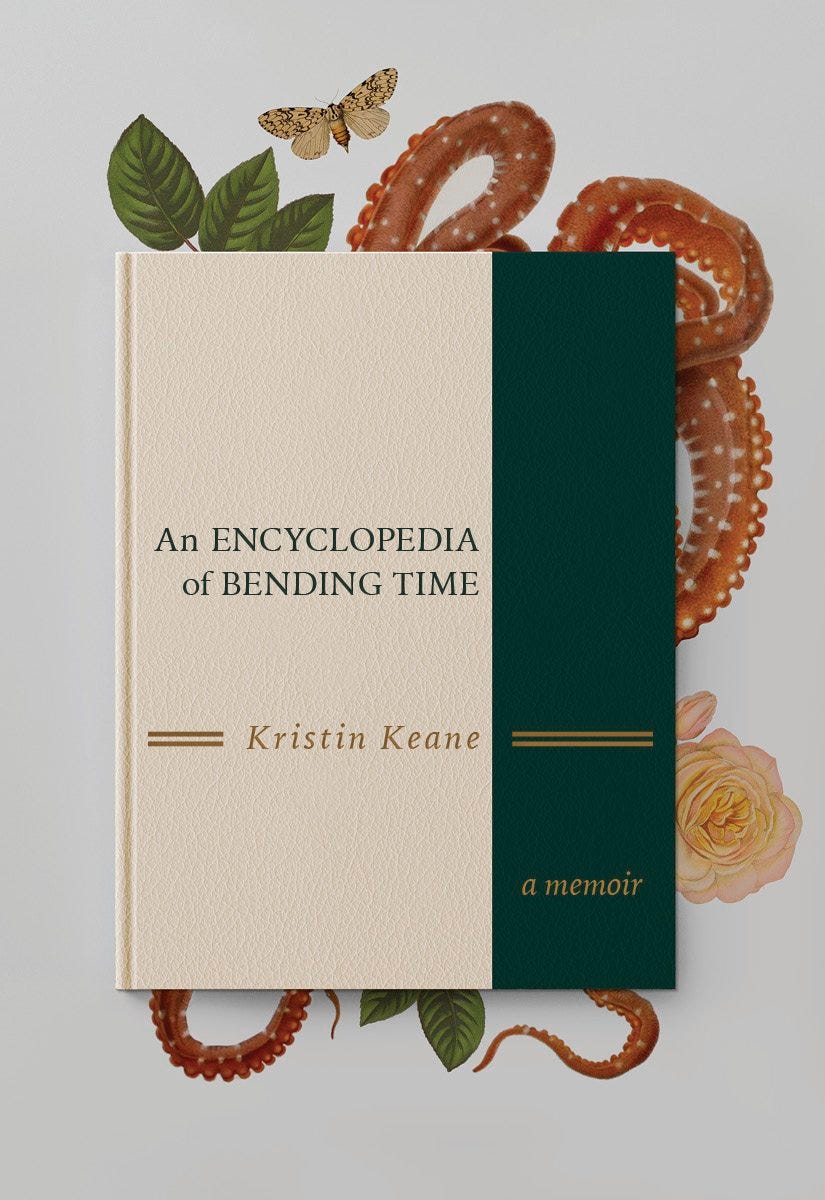
Kristin Keane’s gorgeous book: An Encyclopedia of Bending Time is an unconventionally structured memoir with impossibly precise prose that works to define the true shape of grief; to measure the immeasurable and to ultimately give a second life to her mom who has passed. Through an alphabet of memories, she aptly puts down on the page how desperately daughters need mothers to leave them something tangible: a legacy, a community, a true sense of self — but how impossible it is, as a mother, to give just this thing — because in order to do it we have to leave our daughters behind. Everyone knows the pain of that leaving; we all had a mom; she had to leave too, and we also know how they did it with such little to gain from the leaving. The impossible bind of motherhood.
The writer uses memories, categorized and cross-referenced and organized alphabetically to mourn her mother’s death in a rigorous and logical way — a way, which she tells us, is counter to the way her mother lived life. Her mom lived symbolically, mystically, and narratively, though perhaps, more than anything, mythically, as we are all want to do — through the stories that others tell about us, about women. Wound through the book are vivid descriptions of philosophical ideas — the way time works or the way death works — according to known writers, along with nostalgic references to TV shows she has always inhaled. The story is grounded with thorough definitions of places and objects, giving things a parallel meaning, both objective and subjective, thought at the very same time.
One poignant entry — titled entry — describes the motherly worry about a daughter far away, exacerbated by a missing package she sent that was meant to arrive in time for a birthday. She, the writer’s mom, fixates on the rolls of coins that she included, as if by sending her money, she had caused the gift to lose its way, as if she were responsible for having lost it herself. When the narrator recovers the package, they both come to learn that the box, having been already delivered, was only misplaced, with all of its contents — a pair of cotton pajamas stamped with flowers, a butterfly wind chime, containers of her favorite peanut butter and a package of gummy bears - still enclosed.
I’m just so happy it got there, her mom says to her, when she delivers the news. I’m just so relieved it made it in time.
How does the meaning of this entry change now?
This is a way for the writer to talk about about the topic of time and her wonderings about how what it means changes once you’ve lost something great. The meaning of life is made through her language, the life of her mother sustained and maintained through the stories she tells. Questions about the possibility of an afterlife come up in the section called Ghosts, when the writer asks whether a ghost can be held. The entry named Quantum Leap, only hints that the narrator is willing to entertain something more than the body, and more like a soul, through noting Wolfgang Pauli’s discovery of the particle that can not be detected. Some of this science is based on faith, she says, but I accept it too.
The whole text is glorious and structured in the way so many pieces will want to be written, in the future, but so many writers will fail to accomplish, because of the depth of feeling it requires to get to a place where all time collapses and all stories seem to be so linked together such they are impossible to pull apart. It’s the kind of thing you can only write from a place of full grief and your own sense of wrenching yourself from something you care about deeply.
This flattening of time allows for the writer to revisit her mothers death in a million ways, not only through memory but with moments of her death and the first days of grief. In one story, I cried, when she encounters another another woman grieving her mom, who had also passed, recently but not so rawly so; how strangers can echo you or pre-echo you, as this woman had for the writer, in passing.
In a section titled fix, the writer tells us (I think, for the first time - but I have not read this chronologically as in page after page) about the difference in time between the death and the document of death, but includes a rift with a hospice worker who can not accept the actual time of death, and how the writer is willing to think about whether that means that the death is negotiable. Later, she revisits this fact: you took your last breath at 4:40pm but your time or expiration is listen at 6:15 pm on your certificate of death (p78), in a section called many-world interpretation, which deals with the topic of the limits of measurements.
Is a dead flower dead when it is actually there, the writers asks us to consider somewhat early on, in a section called Ayrshires - a rose, we are told, that can live in very harsh conditions. It is not until late in the book that we find out more about some financial hardships, though the physical hardships of illness are present throughout.
The section called Returns Regarding the Thing I Cling To is the most present, the least ruminative and the most razor edged and describes how death leaves us alone with the question of what to do with one’s own body once the loss has occurred. I sat on your bed. I tried to put myself where you used to lie. I tried putting my body in the same place where you slept. I put my face in your clothes. I loved this portion becauseI felt the eroticism come through, this deep love for the mother and all it entails, and the impossibility of becoming that which never became.