

AGAINST EXILE
One Piece #5: Shirin Neshat’s Rapture

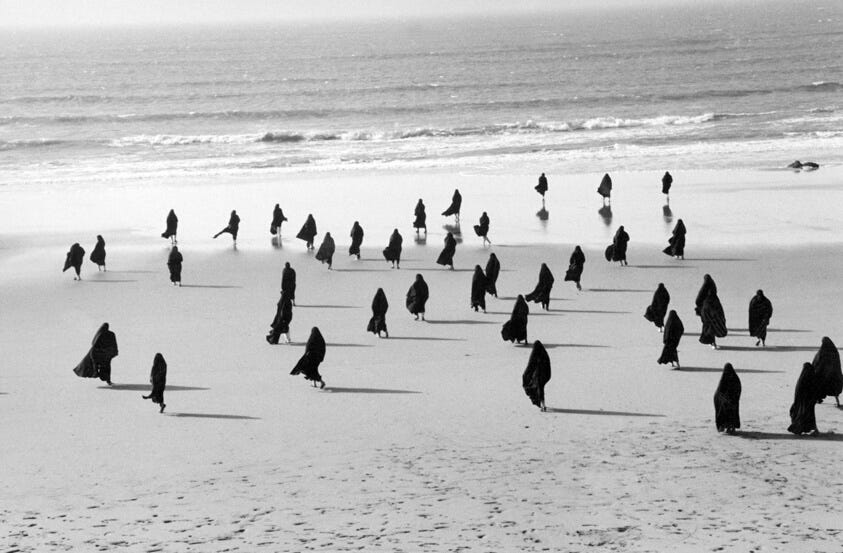
For a long time, I was obsessed with a video I saw at the Whitney, back when the Whitney was that bulky building on the Upper East Side with carpet everywhere and a sculpture garden that I remember as being closed all the time.
The entrance was ugly and concrete, and the rooms weren’t much better. We wandered up the floors until we reached the top, when I found that all the artwork began to speak a bit to each other. There seemed to be a reason one piece was placed where it was, and a few led me deep into the corner room, like a choose-your-own-adventure.
That was where I fell in love with Shirin Neshat’s video, Rapture.
The movie is broken up into two screens. In one, the figures are women dressed in black chadors, moving around the landscape of the sea. Their bodies are like sculptures, with strong profiles, and their retreat into the distance leaves them looking dispersed across the barren land. You can tell that they are pushing hard against the strength of the wind.
On the other screen, the figures are men, dressed in uniform, moving around the architecture inside. They march with militaristic intent through cobblestone walls wearing white shirts and black pants, and climb in a rush to the top level, where they hoist a ladder up to the edge. Some with access clamber to the top of the walls, and others fight amongst themselves down below.
The ones that can line up at the city walls and watch from above as the women collectively push a heavy-looking but also stripped-down wooden boat in the water. And then they get in. The message is about the split spheres, the exiling of the women to barren lands, and the dark, open possibilities of the ocean, and where it might lead.
But I don’t remember that movie. What I remember is something so different. I remember the women IN the city, in their same black cloth-covered bodies, central and strong. The wind was as heavy as ever, but the romance of the cobblestone was aptly protective. I remember the depth of their eyes as they surveyed the sea.
I do remember that wind. I was in that fortress where the art film is made. I had been in Essaouira in 2000, in the spring of that same year, and the castle-like architecture that lined the edge of the city was the only part that I was bold enough to explore. We had walked on the stone, my boyfriend and I, lugging our luggage along with us since we hadn’t yet checked into our hotel—the one with the courtyard, the room with two levels. It was in that room that I had my first orgasm during regular sex, exhausted by the travel and by our long walk in a sandstorm on the beach by the fortress. I had been too tired to push the pleasure away. The sand was sharp when it hit our legs, and yet we walked out as far as we could before someone ran out onto the beach and surprised us. I felt scared, and we returned to our hotel, and I lay down on our bed. I can remember the bottom of my long orange skirt, then up to my waist.
One description of the actual video reads like this: men appear confined within their culture, and women, by engaging with nature, are ultimately empowered to leave the boundaries of their culturally defined roles. I’m not sure that’s what I saw. Dragging a small wooden boat into the water does not resonate with ‘engaging with nature.’ And taking that boat into the ocean with no supplies does not seem empowered or even a choice, although I will agree that it is, in part, ambiguous.
Maybe that was why I remember the women inside the walls - moving through the stone space, with their eyes to the water. I remember a close-up view of one woman looking over the edge.
My younger self might have felt there was a romance in leaving. We don’t know why the women are exiled, but also WE KNOW that they are stronger despite having no structural support and being out fighting the elements. But a part of me did not want the women to be lost at sea. I did not want the men to inhabit the building. I wanted women, as their whole bodies, to be a part of the structure. I wanted myself, through these women, to be welcomed in.
So in a strange and fantastical way, I made something else up.
I remember them twisting in a choreographed way through the structures at the edge of the city. The city was spacious, the thread of women loose but still organized and moved in great order. They spiraled up the structure not to look outward but to stay inward — to know their own purpose and to be central there.
I am amazed at the power of this and also the insanity. How easy it is to see myself in something that I’m not a part of. I’ve always had this strange power, one I’ve started to fear. Until I became a mother, I was not afraid of moving places I wasn’t welcome.
In my memory, there’s no conflict between inhabited and wild, between safe and free. In this movie is the version of my very best lover - one who set my imagination on fire.