

10,000 STEPS
A Dance About Its Own Making

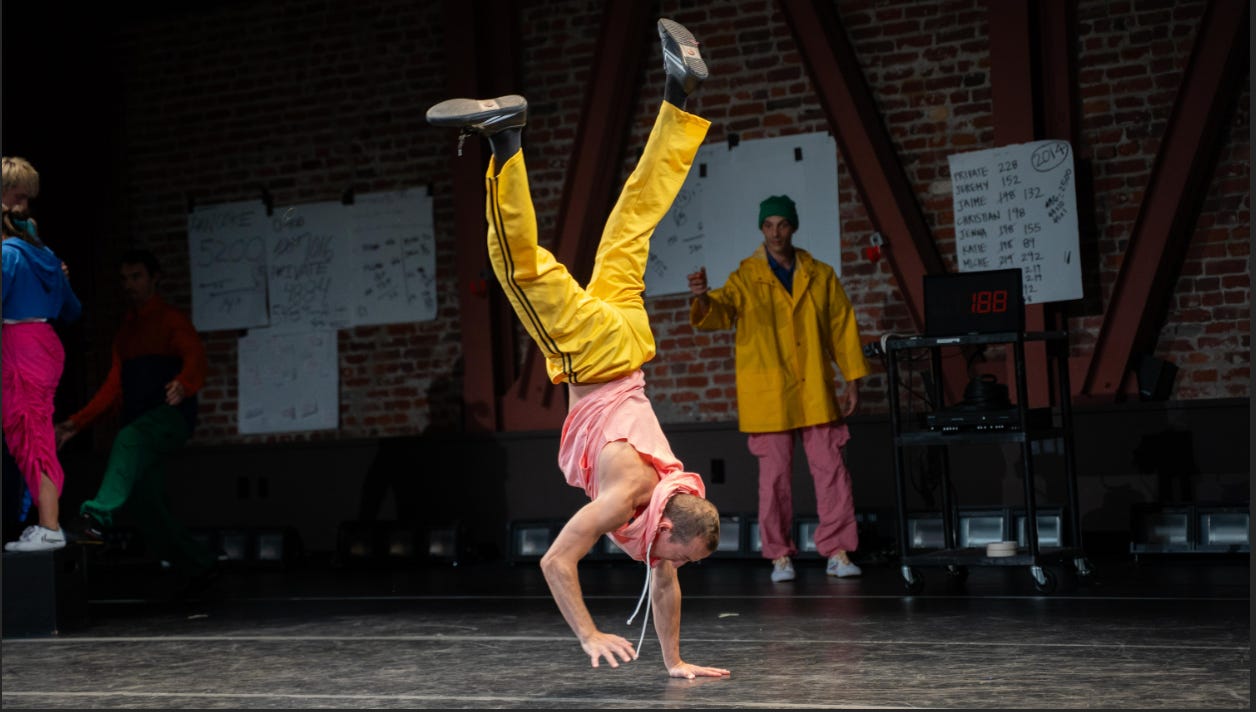
I have a story about Catherine Galasso’s dance piece, 10,000 steps, and here’s how it goes. The first section is about how our generation is defined by a collective understanding of what’s positive. And this has some positive results. For instance, happiness, health, community and individual expression are the touchstones for millennials and beyond. The performance communicates this right away: the dancers are dressed in comfortable colorful clothing and they each find a way to dance across the blank space of the stage in their own unique way, while the others watch. Meanwhile, a designated counter fixes their stare on each person as they dance, clicking to track each step. A large digital ticker sits center stage and the red numbers increase with each step and each click.
The movement is playful. One dancer rolls across the space, managing to get all the way without advancing the counter. Another uses a wooden box to remain in the space without getting counted and someone else takes up as many steps as possible while pitter pattering with small steps through the dance space. Someone else rolls on one roller skate in a diagonal and with graceful balance moves through without getting clicked. Dancers joins together in pairs and their steps get counted twice, even if they move uniformly. The section of the dance ends with the whole cast walking arm and arm in a march, culminating in their first major milestone, which if I remember correctly was 1,000 steps.
The second section gets a little darker. As they continue dancing and counting they get exhausted. Some fall to the ground while others hold out as long as possible, contributing to the increasing number without any evidence of play in their task. When they hit the floor they seem more like toys that have used up all their batteries. I think this is asking the audience to consider the issue of burn out. Where has all this externalization of goals gotten us? Are we any healthier? Have we achieved any better connection with others? Or have we just lost sight of ourselves in pursuit of our goals? The group ends lying in a slug-like pile and begin operating their bodies like a human conveyor belt—moving themselves by rolling over each other until they form a clump the back of the stage.
Now comes the good part. The group stands up and looks towards the front of the stage in the opposite corner, as if they are looking for a ship on the horizon. Only it’s foggy. They can’t quite seem to see what’s out there. They look a bit confused as they move toward the front of the stage in a diamond like formation. I read this as a question about our futures: where will all this counting and self awareness take us? If I interpreted the next part correctly, the choreographer’s answer is straight to hell, if hell is a goth club at midnight.
The lights turn red. One of the dancers is acting as the DJ in the back of the space and the others make their dance expressions more heavy and colloquial, one even sticking her tongue out with adolescent rebellion. It feels as if these characters have not grown up, not even a little, and that they have just as many issues as they did before they started reaching for their goals. Maybe it’s just me, but this felt like mid-life where, if we’re lucky things don’t make sense. We feel angry and discontent. We are able to reevaluate ourselves and honor that life isn’t about an upwards climb, unless we are considering death as the ultimate achievement.
The audience cooled a bit during this section which I only noticed because I did not. Instead I moved my own body with the beat and felt, for the first time in the dance, to be totally at home. I’ve never been comfortable with optimism. Goals have always felt a bit empty to me. If I could spend all night every night in the fog, with house music, and many half naked people close by, I probably would. Even that childish devil, with her tongue stuck out in a non-random fashion felt more like a friend than the cheerful joggers who delighted in each other’s contribution to the whole at the start.
There’s a strange and wonderful fourth section that stands out on its own. The group is huddled together and one person steps out to give us a speech about the benefits of movement in a way an encyclopedia might. The character, played by Jenna Marie, uses a robotic but urgent voice that could be described as a TED talk given by artificial intelligence. The content of the speech is about the connection between our biology and our psychology and the premise is that both depend on movement to thrive. The speaker in herself has a strange affect but then another dancer creeps behind her, holding a clipboard and whispering the text of the speech to her into her ear from behind. I’m not clear on the reference for the whisperer but Clockwork Orange comes to mind. This section is emotionally more resonant—using darkness to deal with the uncomfortable truth that what we know can’t help us. So what if our most basic functional and cognitive needs require us to move? The fact in and of itself doesn’t create a change in our sedentary lifestyles.
The dance ends abruptly. When the clock reaches 10,000 there’s a short boomer style dance party and the clock displays phrases as well as numbers. In a surprise move, my neighbor in the audience, exactly the target age for this message, gets invited to join the dancers for a final shimmy before the piece is complete. It feels a bit anticlimactic but as far as the narrative goes this works. Achieving something or coming to completion doesn’t always leave you any closer to yourself. You either have to reset the clock or just keep on counting.